

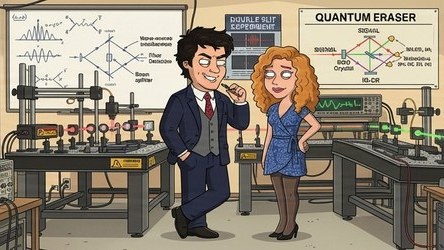
I didn't want to touch this topic, but it's such a sprawling quantum bullshit that I couldn't hold back. In any case, I hope you'll find it interesting.
Imagine, dear reader, that you've graduated from the physics department of the private and very trendy Johns Hopkins University, which has hosted 26 Nobeleeches at various times.
A hell of a lot of cash was dropped on your tuition. You studied, you gnawed at the bedrock of science. You almost broke your teeth. You busted your ass and became a theoretical physicist.
You’re young and strong. Your soul is bursting with ambition, and your head is exploding with the urge to make a discovery on the tip of your pen. And preferably in the most fashionable, stylish field: quantum physics. Too bad all of quantum physics is already taken.
Einstein and Planck had already invented quanta.
De Broglie had already cooked up and implemented wave-particle duality, slapping a wave psi-function onto a corpuscle.
That arrogant pretty-boy Dick Feynman had already run his mental electrons through mental slits, mentally cut into a mental vacuum during his lectures, producing a mental striped interference of a mental electron on a mental screen - making his young female students soak their panties.
Even Heisenberg, while busy tinkering with an atomic bomb, managed to make a name for himself by inventing the probability cloud and Heisenberg's uncertainty principle.
Basically, no matter where you spit, you’re bound to hit a quantum Nobeleech.
And every single one of them gets mad respect and props.
And they all pull in at least 100 grand in greenbacks a year.
At this rate, any theoretical neophyte would sink into despair and depression, dropping the hands that tightly grip the pens on whose tips future discoveries are supposed to be.
You know, the ones 'on the tip of a pen.' And they’d probably end up hanging themselves with those very hands.
And that’s exactly what happened to Johnny Wheeler. Realizing that the quantum field had already been plowed through and that all the juiciest quantum treats had been devoured before his time, Johnny spiraled into depression and decided to settle scores with this ruthless, treacherous, cruel, calloused, stupid, ungrateful world.
He asked his bros from the chemistry department to score him some acid.
He downed it and waited for the glowing tunnel to heaven to open up. But his chemist buddies apparently misunderstood Johnny.
And what opened up to Johnny wasn't just a tunnel to paradise. The entire universe unraveled before him. His consciousness expanded, collapsed, expanded again, and bent into a freaking arch.
And just like that, Johnny started pumping out quantum entanglement, geometrodynamics, gravitational collapse, wormholes, quantum gravity, and that ultra-badass informational physics that ground the quantum-relativistic bullshit into absolute dust.
So, here I am, holding a steel ball bearing in my hand.
What do you see? Well, some roundish lump of matter, a corpuscle, a particle of substance with a closed outer surface and a finite size.
Now, de Broglie would also see a matter wave, and Heisenberg would spot a probability cloud of where the ball might be.
But if you ask Louis de Broglie: 'Where’s the wave, Louis? I don't see any wave. Show me, Louis. I see a ball, I see a particle, I can feel the corpuscle with my own tentacles.'
Louis will turn red, get embarrassed, shut up, and skedaddle.
Same question to Heisenberg: 'What are you babbling about? Where’s the cloud? Where are the probabilities? It’s a ball, a chunk of iron!'
Heisenberg will lose his nerve and hide behind the drapes.
But just try asking Johnny Wheeler that same question. He won't even blink before giving you an answer.
Johnny will say:
'Dude you are seriously tripping! That ball you're holding in your hand only became a ball when you decided you wanted to have it there. And it figured that out by reading your mind from the deepest corners of your subconscious. Until that exact moment, until the spark of mutual chemistry and trust flew between you two. The ball didn't exist at all. Period. It wasn't there. There was just a probability cloud of the ball existing somewhere in the universe. Anywhere, really, though with different odds, obviously.
But when you thought about having a ball in your hand, you sent information to the Universe. Then the Universe passed it along to the ball's probability cloud, letting it know you wanted to hold it. The Universe exchanged information with you, double-checking exactly where you wanted to see and feel this ball.
Obeying the order, it commanded the ball's psi-function to collapse right into your hand in the form of a ball. Look, dudes, nothing in this world exists as a material object until an observer lays eyes on it. Not until we, the observers, decide we want to know about its existence and sneak a peek at it!'
Now do you understand, dear reader, why compared to Johnny Wheeler, all the other quantum physicists are just dandruff under his fingernails?
For this alone, Johnny definitely deserved a Nobel. But the jealous haters refused to give Johnny his Nobel, so he came up with an even craftier plan.
Picture a screen. It has two slits, just like Young’s experiment. Waves of matter pass through it, just like de Broglie said, or maybe probability clouds, like Heisenberg suggested.
But you don't know a thing about it. You aren't peeking at Heisenberg’s clouds or de Broglie’s waves. You’re completely ignoring the psi-function. Your back is turned.
So, while nobody’s looking, de Broglie’s matter wave - aka Heisenberg’s probability cloud squeezes through Young’s slit. Unlike particles, it doesn’t have a size; it stretches across the entire universe, with varying odds, of course.
Long story short, this wave or cloud slips through the slits, interferes with itself, and collapses right onto Thomas Young’s screen, landing neatly in one of the interference stripes.
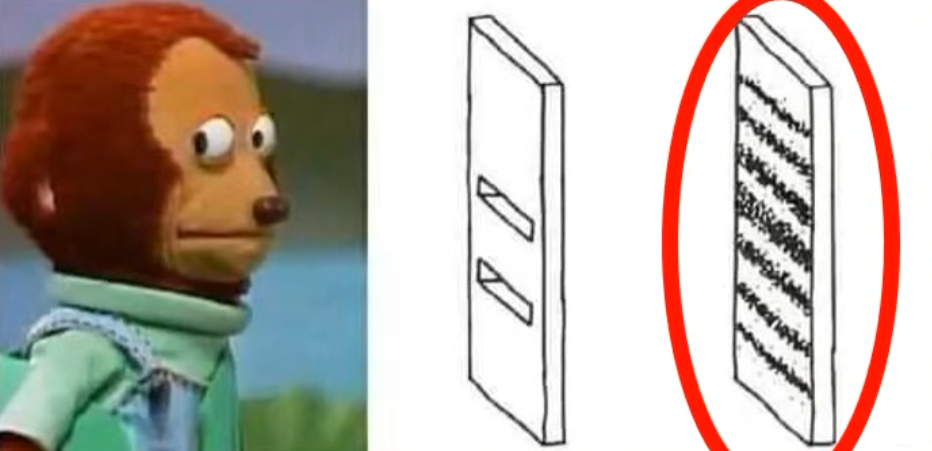
But what happens if we actually peek at the probability cloud and find out exactly which slit the psi-function was slipping through right before collapsing into interference stripes on the screen?
Naturally, the particle's probability cloud will collapse, and it will materialize in one specific slit:
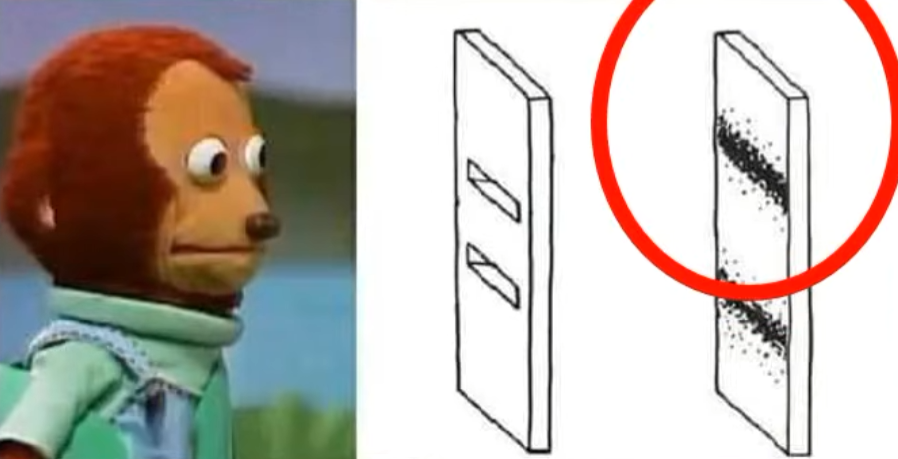
After all, unlike the psi-function, it’s a particle, which means it actually has a size. And that size is tiny way smaller than the distance between the slits. Even a psi-function, once it turns into a particle, can't squeeze through two slits at the exact same time.
So, here’s what happens: the particle's probability cloud exchanges information with us observers, collapses inside one of the slits, materializes right there, zips through it, and leaves just a single mark on the screen directly opposite that slit.
No interference, obviously. And that’s how it goes for every single particle. As a result, instead of beautiful interference stripes on the screen, you get a boring, blurry smudge.
Feel the difference. Beautiful interference stripes if you don't spy on them, and a dumb, boring, blurry smudge if you do.
Johnny’s buddies, the watered-down quantum physicists, had a good laugh at his plan:
'How are you going to prove that a photon slipped through a specific slit? Put a detector right there on the track?' they mocked.
'Well, that detector is just going to snort the particle right up, absorbing it completely. It won’t even make it to the board to leave those pretty lines. All you’ll get on the screen is a mark from the second slit - just a dumb, blurry smudge.'
But Johnny, who had already run a fair share of experiments with clouds, lines, particles, and slits, knew things that were entirely out of their reach:
'Dudes, you're trippin so hard I can't even handle it. I’ll just postpone figuring out which specific slit the cloud preferred to collapse into!
I’ll only look into it after it’s already hit the screen and collapsed.'
Like hell you can,' the quantum boys scoffed. 'You can't find out which particle slipped through which slit without snorting it. And if you snort it, it won't hit the screen, and you won’t know a damn thing.
'Oh, you're dead wrong,' Johnny fired back. 'Dead wrong! I'm not going to snort the entire probability cloud. I'll take a part of it and split it in half.
Let one half head toward the screen and collapse there, in those pretty lines. And I'll move the second half to the side and let it collapse later, in a special box.'
'Nah, that doesn't fly!' his buddies argued. 'A quantum is indivisible; you can't split it. What's wrong with you, dude?
Did you skip class? How did you even graduate from university?
‘You guys just don't get it, dudes. I’m going to use quantum entanglement. I'll take a photon in the form of probability clouds, run it through two slits while it’s still a probability cloud! Without caring which slit it - the photon-cloud - is squeezing through.’
‘For example, say it slipped through slit "A" - but I don’t know that. Since I don’t know, since I’m not asking any questions or exchanging information, it stays a probability cloud. It won’t collapse into a particle inside the slit.’
‘On the way out, this photon-cloud gets sliced into two entangled photon-clouds by a Glan-Thompson prism.’
What are quantum-entangled photons?
Let me break it down. Take this pair of stockings, for instance, that’s your photon.
I’ll separate the pair into two individual stockings. In the quantum crowd, this is called 'photon splitting.' These two stockings right here are your quantum-entangled pair.
Why entangled? Because they were stitched by the exact same Chinese worker.

Why can’t we just call them stockings?
Because according to the quantum canon, a photon is indivisible - it cannot be split. Yet, you have to account for the exact identical nature of these particle-photons somehow. That’s why stockings stitched by the same Chinese guy aren't called 'identical stockings,' but a 'quantum-entangled photon pair.'
These stockings - this entangled pair - possess a number of unique quantum-mechanical properties. First and foremost, they have this very 'quantum entanglement.' How does it manifest itself? Quantumly, of course.
Now, what do you see? Two stockings?
Well, a quantum theorist sees an entangled pair of quantum states.
What is a quantum state? It’s a set of quantum numbers that characterize a quantum physical system. For example, stockings have a certain set of properties: length, color, denier, and mass.
The quantum physicist assigns a specific quantum number to each of these. That concrete set of numbers is what they call the quantum state of a physical system.
For the sake of aesthetics and authority, the quantum physicist drops these quantum numbers into a neat little quantum table.
The quantum physicist doesn't care about actual matter or the objects made from it. Matter is often dirty or heavy. And many objects make too much noise when they operate, or they can scratch the quantum physicist, or painfully pinch his finger.
That’s why the quantum physicist just sticks to quantum numbers. They’re clean, they don't weigh down his pockets, they don't smell, they don't make noise, and they are completely submissive and obedient. He can aggressively screw them with mathematics in every possible slit without any fear of criminal charges or physical injury.
These stockings - this quantum-entangled pair - or rather, their quantum state, possess some sort of additional quantum properties.
I’m going to call it the 'spin' quantum number, and it can take on the values of 'left' and 'right.'
Notice anything? Exactly.
A sharp reader will definitely ask: how on earth did the quantum physicists find out that this entangled pair even had these properties if they couldn’t interact with the damn pair in any way?
How do you know anything was even there to begin with? Alas, I cannot give you an answer to that question. You’d better ask Johnny Wheeler, or at least that pretty-boy Feynman.
But let’s move on.
Now, pay close attention. I take this stocking here - entangled photon number one - slip it onto my left foot, and realize that its 'spin' quantum number has the value 'left.'

And look at that: at that exact same split second, without a single moment wasted, the spin of stocking number two, which is entangled with it, instantly took on the value 'right.'
Mind you, this happened instantaneously, with zero time elapsed. And the distance between the entangled members of the pair doesn't matter in the slightest.
Whether it’s 1 millimeter or 10 parsecs. The moment I figure out that I’m holding a photon with a 'left' spin, it becomes instantly crystal clear to me that the other photon entangled with it has a 'right' spin.
What’s happening looks like the instantaneous transmission of information across any distance. Except, obviously, it isn't. The spins of both partners in the entangled pair took on their values the exact moment I put the stocking on.
But this information was never sent anywhere. It never even left my head. In fact, the only person who even knows that these entangled photons are actually entangled is me - the observer who saw them form and who can identify and track their destiny.
The photons themselves - the entangled pair - live completely separate lives from the moment they are created.
So, if you do something to one of the photons in an entangled pair, it won’t have the slightest impact on the other fragment, regardless of whether it’s close by or far away.
Basically, you cannot influence one partner of an entangled pair through the other partner of that entangled pair.
But the quantum crowd slickly bypassed this slippery slope. It goes like this: 'Upon any change to any component of an entangled pair, the entanglement between them vanishes.' Simple, elegant, and completely bulletproof.
‘So,’ Johnny continued, ‘at the exit of slit "A" - which I have absolutely no clue about and couldn't care less about - the photon, whose name is now "A" after the slit that birthed it, slams into the knife-prism and splits into an entangled pair.’
‘One of its entangled parts is routed to the screen and collapses into one of those interference stripes. But I don’t care about that. I know nothing about it, and I don’t want to know.’
‘The second part keeps moving forward and drops into box "A." And that’s where it eventually collapses.’
‘Meanwhile, the photon that squeezed through slit "B" also splits into an entangled pair. One half is routed to the screen and collapses into one of the stripes. The second half keeps moving forward, drops into box "B," and collapses there. I’m going to repeat this procedure a bunch of times.’
‘Pay attention: I still don't care which photon went through which slit, or which of the entangled scraps ended up in which of the two boxes.’
‘And that means the entangled fragments of photons on the screen will form - what? A striped interference pattern. But if I peek inside box "A," for instance - which only holds the ones that slipped through slit "A" - then I will know for sure.’
‘The scraps on the screen will also find out about it instantly. They’re entangled, after all. And those scraps on the screen will have no choice but to redistribute themselves into a blurry smudge!’
The stunned quantum physicists exchanged glances. A profound silence fell over the room. And suddenly, the entire depth of Johnny’s consciousness collapsed into their heads all at once, with absolutely no time lag.
'Teach us!' - the quantties cried, falling to their knees aruond Johnny.
And Johnny taught them...
to be continied
Sign in to comment