


In 1999, at the University of Maryland, a guy named Yoon-Ho Kim and his accomplices, Kulik and Shih, were just starting to bleed the cash of gullible sponsors and taxpayers through experiments involving information teleportation across time, following the dogmas of the great Mr. Wheeler.
In the laboratory of the quantum physicist Marlan Scully, they built a delayed-choice quantum eraser. Kim managed to string telegraph wires from the current present into an eight-nanosecond past.
And there, in that eight-nanosecond past, he could generate or cancel the interference pattern on the screen at his own whim, simply by pressing buttons here, in the present.
So, how is this quantum transtemporal telegraph set up? Here is the schematic and the description. I’ll attach the screenshots of the original source:
https://arxiv.org/pdf/quant-ph/9903047
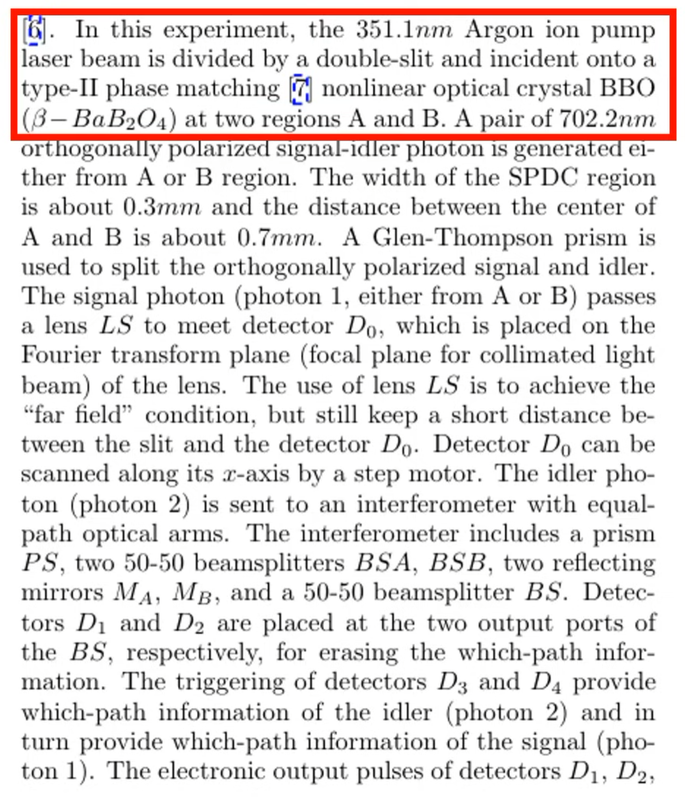
Pay attention: it’s not 350 nm, and it’s not even 351 nm - it is exactly 351.1 nm. This isn't amateur hour. This is a delayed-choice quantum eraser. Accuracy is key here.
What is BBO? It’s Beta Barium Borate - BaB2O4.
What does 'phase - matched non - linear optical' mean? Well, if you translate it from quantum - speak to human language, it’s just a chunk of matter that has the special knack for gluing two short photons into one long photon, thanks to the fact that the speed of light passing through it non - linearly depends on its intensity.
Next, we have a pair of 702.2 - nanometer ones. Got it? And why was it so absolutely necessary to specify the laser's wavelength so precisely? Because you wouldn't have been impressed by the new length value of 702.2 nm. It is, after all, precisely longer than 351.1 in total.
Feel it? Feel the tension and the raw power of quantum skill? Now, light with a wavelength of 350 nm is basically ultraviolet - you can't see it. 700 nm is already dark red. You can see it. That’s number one. Number two, red light is easier for the photodiodes in the detectors to spot. And number three, it easily splits into an orthogonally polarized entangled photon pair.
What is SPDC? It’s just another name for the exact same thing that was called a 'phase - matched non - linear optical BBO crystal' above. Only now, it’s called Spontaneous Parametric Down - Conversion. Why did they rename it?
Well, because it sounds way more scientific and way more quantum that way. It’s no longer just 'phase - matched' and 'non - linear,' but now it’s also 'spontaneous' and 'parametric.'
What is a Glan - Thompson prism? It’s just a couple of chunks of calcite glued together in a special way. This kind of prism possesses birefringence and refracts light differently depending on the direction of its polarization.
In reality, it’s just the focal plane of a lens, but you have to admit - 'the Fourier transform focal plane' sounds way cooler and far more scientific.
A meticulous reader might ask: 'Why all the complexity? Why a tunable ultraviolet argon laser? Why a phase - matched, spontaneous, non - linear wavelength - doubler made of beta barium borate? And on top of that, a convoluted Glan - Thompson prism stacked on?
What’s all this for? Why not just take a regular red laser diode? It’s 1999, after all they could find one in any CD player. Just rig it up with some glass beam splitters set at a 45 - degree angle to the beam.
You’d get the exact same result.
But nope. they can't just do it that easily. What are they going to show the sponsors when they’re begging them for a million and a half greenbacks for an experiment?
Are they going to show them a Chinese laser pointer and a 2x2 cm piece of glass - a setup worth maybe 50 bucks? Hell no. That’s why a proper quantum experiment has everything it’s supposed to have: the argon laser, the beta barium borate, the Glan - Thompson, and all the rest of that high - tech junk.
The authors use the term 'far - field condition' to describe zooming in on the image coming out of the Glan - Thompson prism with a regular magnifying glass. The thing is, a proper interference pattern forms on a screen placed at a distance significantly greater than the distance between the slits themselves.
That distance is what's called the far field. This means detector D0 would have to be set up about 3 meters away from the Glan - Thompson prism. And detectors 1, 2, 3, and 4 would have to go even further out. But the lab is tiny.
So, Kim's crew just slapped a magnifying glass right behind the prism. Naturally, they didn't get any far field. How could they? But the magnifying glass did bloat the image of the stripes in the near field up to 3 millimeters in width. And that was enough for the D0 detectors to actually tell them apart.
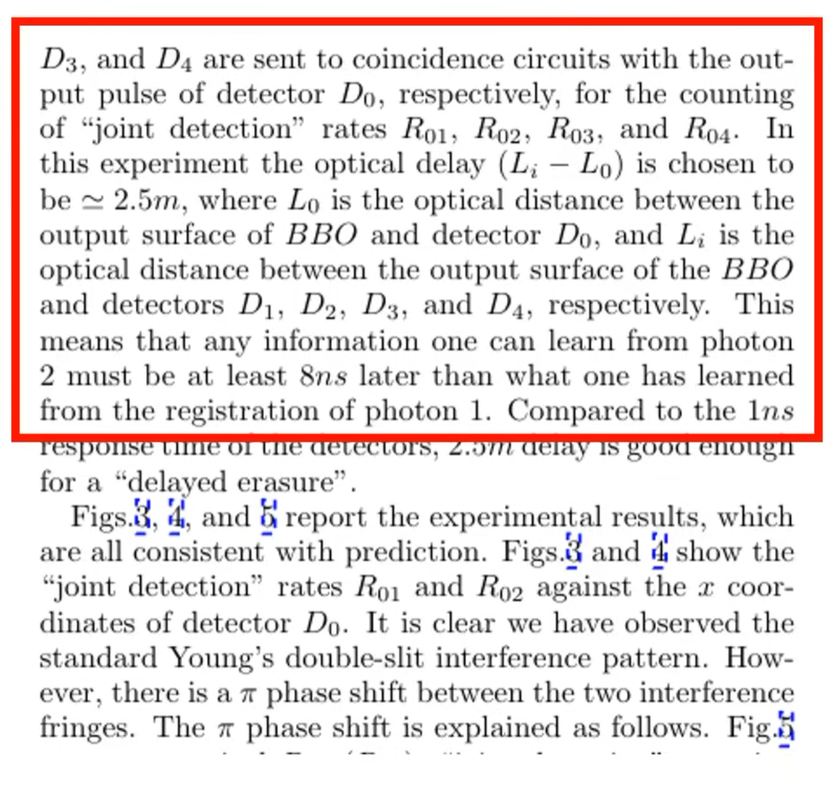
Pay attention: it absolutely must be at least 8 nanoseconds later. Why is that? Why couldn't it be 7, 6, 5, or 3? This will become clear a bit down the road.
Upon reading the words 'as follows,' I expected that an actual explanation would follow, but I was dead wrong. The authors of the paper immediately forgot their promise and jumped straight to the final conclusion.
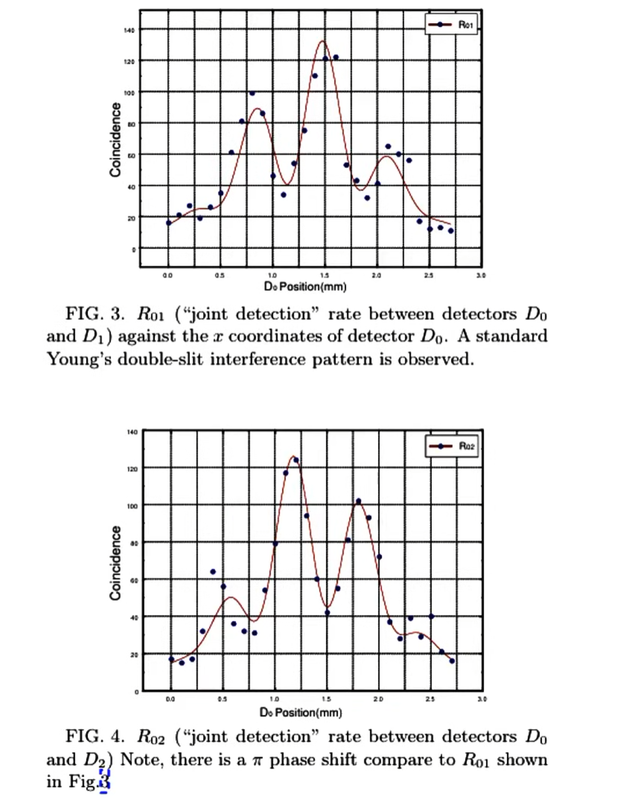
The graphs display the coincidence rate of impulses from the detectors as the x - position of detector D0 changes. R as a function of x: R=f(x).
Yet, the text states that this is interference in the focal plane of lens LS. In other words, it’s the dependency of illumination in this plane on x: I=f'(x).
These are completely different things - like comparing apples to oranges, or warmth to saltiness. On top of that, nowhere in the description is it proven that both functions are identical.
To make matters worse, the graphs of the coincidence rates R01 and R02 relative to x are massively shifted against each other by that very same 'pee - shi(f)t'.😂
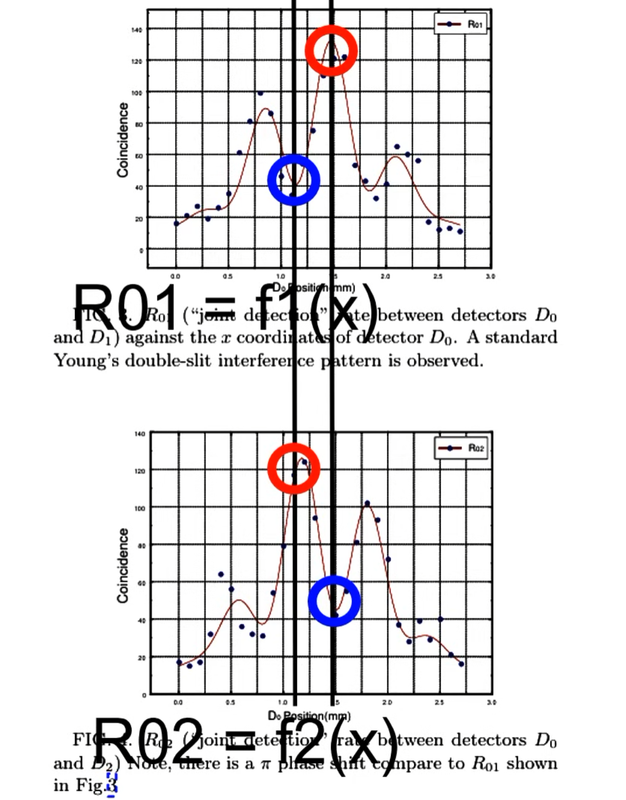
Where detector D1 hits its maximum coincidence, detector D2 hits its minimum, and vice versa. In other words, the function R of x is completely different for the pair of detectors 1 and 2 - despite the fact that the illumination distribution in the focal plane is exactly the same.
This irrefutably proves that what we’re seeing on those graphs is absolutely not the illumination distribution in the plane of detector D0. It is definitely not a two - slit light interference pattern.
So what is it then? What exactly is this scam artist Kim trying to pass off as standard Young's double - slit interference? I have a theory.
I’ll start by exposing yet another fraud committed by Kim and company.
If you carefully read the text in the image, you must have noticed that it constantly talks about 'single photons.'
But neither today in 2026, nor back then in 1999, do single - photon sources exist, nor have they ever existed. There are no lasers capable of unzipping photons one by one. Naturally, there is no such source in Kim’s setup either.
Furthermore, detectors capable of receiving, detecting, and distinguishing a single, isolated photon do not exist now, and obviously didn't exist back then.
And, of course, there were and are no logic circuits that could detect a coincidence in the timing of a pair of femtosecond electrical impulses corresponding to femtosecond photons.
So what the hell was flying around inside Kim’s apparatus then? As is typical for the description of any quantum experiment, you’ll find a massive pile of quantum buzzwords, a mountain of standard theoretical quantum calculations, and an ocean of mathematical formulas.
What you won't find, however, is any kind of acceptable, adequate description of the actual physical implementation of the very theoretical constructs that make up the entire core of the experiment.
Naturally, the description of this quantum eraser experiment contains absolutely no clues as to what kind of 'single photons' were supposedly flying between the slits and the detectors.
But as always, the creators of this quantum illusion show slip up here and there. And if you read the description carefully, you can actually fish out some useful info.
In Figure 2 of the description, the authors casually drop one of the main specifications of their photodetectors: a response time of one nanosecond.
What does that mean? It means the detectors need at least one nanosecond just to form an electrical output signal that matches the incoming light flux.
Meanwhile, the duration of absorbing a single photon with a wavelength of 700 nm is roughly 3 femtoseconds.
This means that during the absorption of a light pulse of this duration, the detector would only manage to change its output signal by about one - millionth of the value it’s supposed to show. In other words, the detector will show absolutely nothing.
Second: the energy of a single, isolated photon with a wavelength of 700 nm. According to the quantum canon itself, it amounts to hν, which is 3 × 10⁻¹⁹ Joules.
Not a single photodetector known to metrology is capable of receiving light with an energy of this magnitude and detecting it at the input against the background noise. There are no such technologies. Not in this lifetime.
This means Kim could not prove that single photons were flying around.
This means these were thick bundles of photons - light pulses, albeit very short ones. In the description of the experiments and the setup, Kim and his buddies, of course, did not specify the parameters of these pulses - neither their energy, nor their duration, nor their repetition rate. But one can still guess a few things.
The detector response time of one nanosecond that leaked into the description gives me an idea of exactly what kind of detectors were used in Kim’s attraction.
A good avalanche photodiode, which is typically used to detect very short, very weak light pulses, already had a response time of around 100 picoseconds at that time - meaning it was 10 times better.
This means that, with a high probability, regular photodiodes were used in the experiment. And that means the light that such a detector could reliably register - the 'power' of this light, so to speak - was on the order of a milliwatt of flux power.
Consequently, the duration of such a pulse could not be less than three response times - meaning at least three nanoseconds, or better yet, 8 or 10.
From here comes the requirement to delay the choice by 8 nanoseconds.
If the delay duration is shorter, an 8 - nanosecond pulse will simply merge in the coincidence circuit with others, and it will simply stop working. Completely.
This means that, with a high probability, the power of the light pulses entering the detectors was at least fractions of a milliwatt, and the duration was no less than three and no more than eight nanoseconds. Well, let's say five.
Pulses of this duration will be more or less steadily detected and will not merge into a continuous signal within the coincidence circuit. At the same time, their duration will be sufficient to detect the coincidence of impulses from different detectors.
Since the duration of absorbing a single photon is roughly a million times shorter than the duration of a five - nanosecond pulse, it is clear that the pulses at the detectors contain trillions of photons, and it is impossible to distinguish them within a single pulse.
And, consequently, every single one of the pulses from the laser triggered a response from all the detectors.
Now I will try to guess the frequency of the pulse generation by the laser.
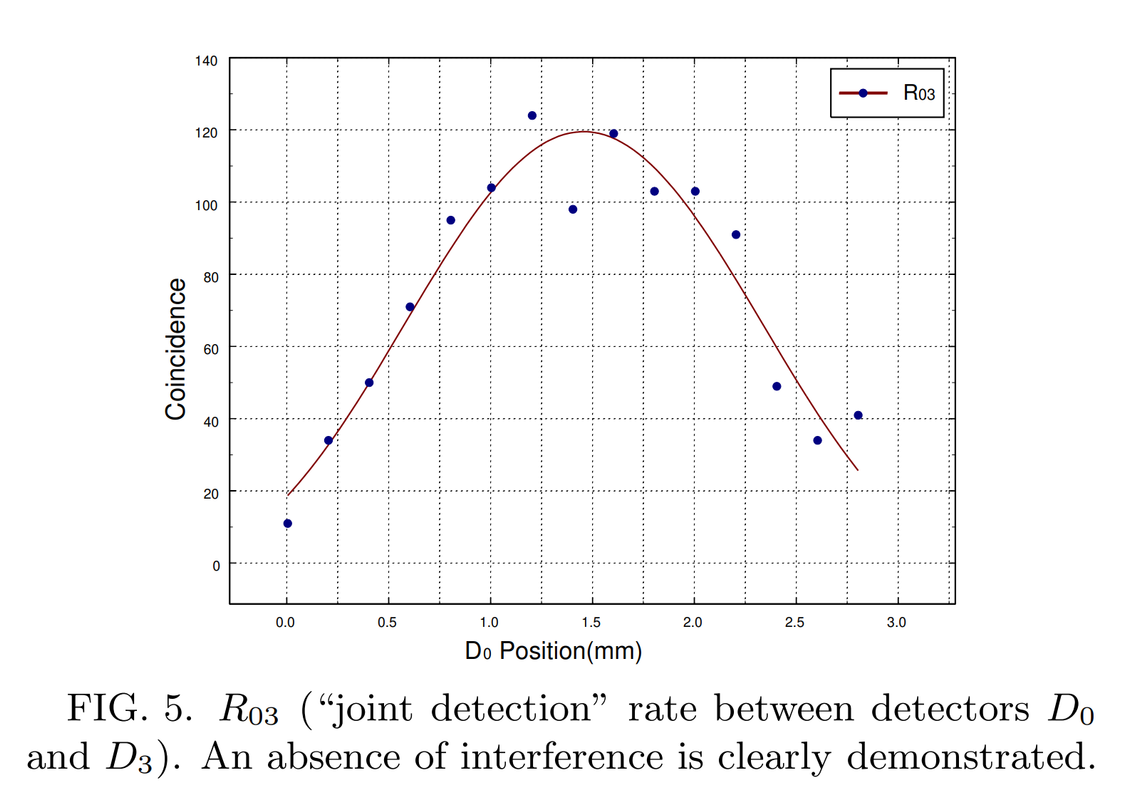
If you look at graphs 3, 4, and 5, you can notice that the coincidence rate on them never exceeds 150 coincidences per second. Let's assume that, on average, every tenth coincidence of the short five - nanosecond pulses is reliably detected.
If we are to believe the graphs, this would mean that the laser generated approximately 1,500 pulses per second. That is a frequency of 1.5 kHz. I will trace the path of each of the light and electrical impulses from the laser to the detectors.
So, at a certain moment in time t, the argon laser emits a pulse of ultraviolet light with a duration of approximately 5 nanoseconds:
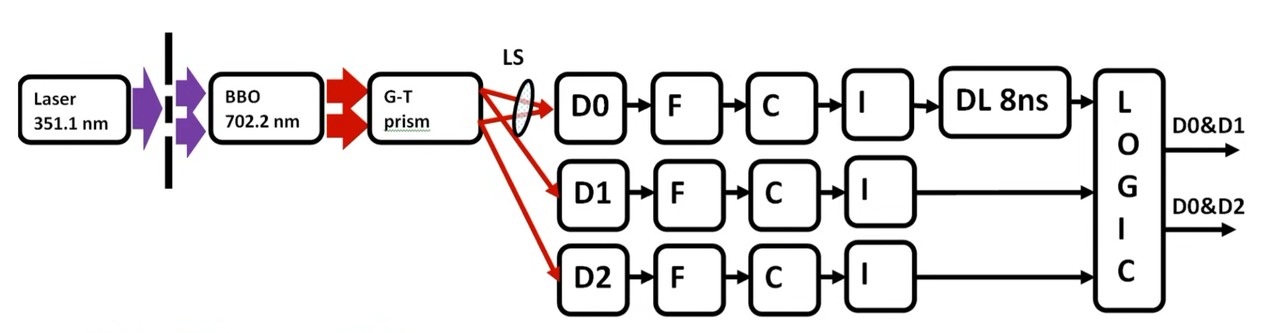
The pulse splits at the two slits, converts into red light on the BBO, splits once more in the Glan - Thompson prism, and is directed along four different paths.
Two pulses from the two slits are directed toward the screen detector D0, interfere in the focal plane of the lens, and produce a striped pattern of illumination distribution.
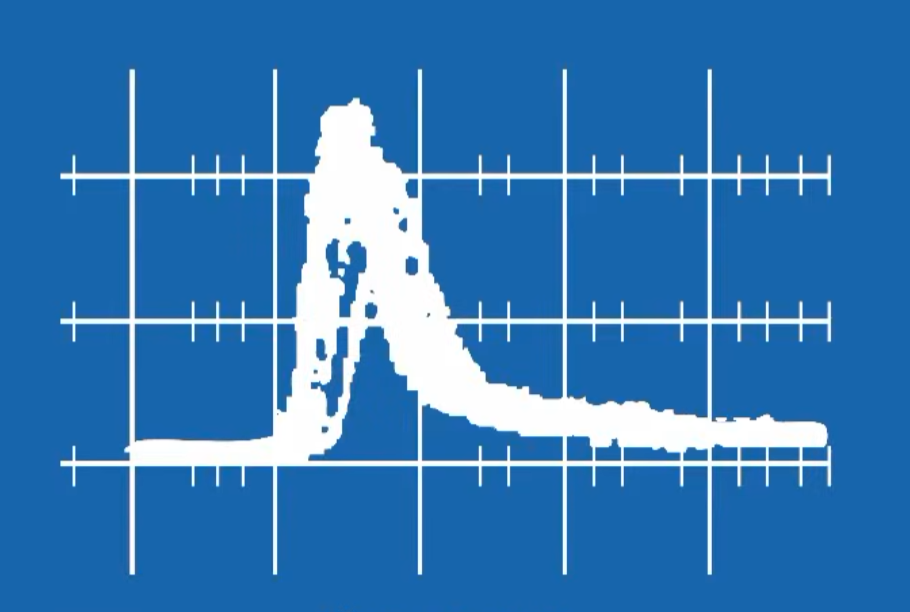
Detector D0 absorbs the light and outputs an electrical impulse, the magnitude and duration of which are directly proportional to whether it landed in a bright or a dark stripe. The shape of the impulses is far from perfect. It looks roughly like this, only worse:
It gets groomed a bit by the input filters. It turns out roughly like this:
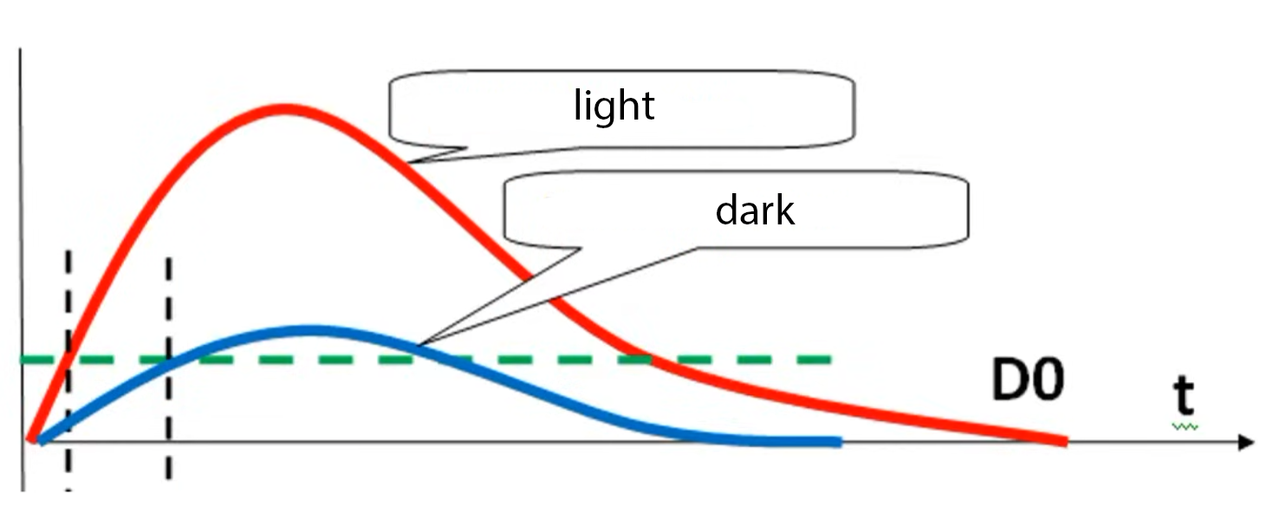
The red line represents the light impulse from the detector when it is in a bright stripe. The blue line represents it when it is in a dark stripe. These stretched, sloped analog impulses enter a comparator, which shapes them into short, rectangular digital impulses of a standardized width.
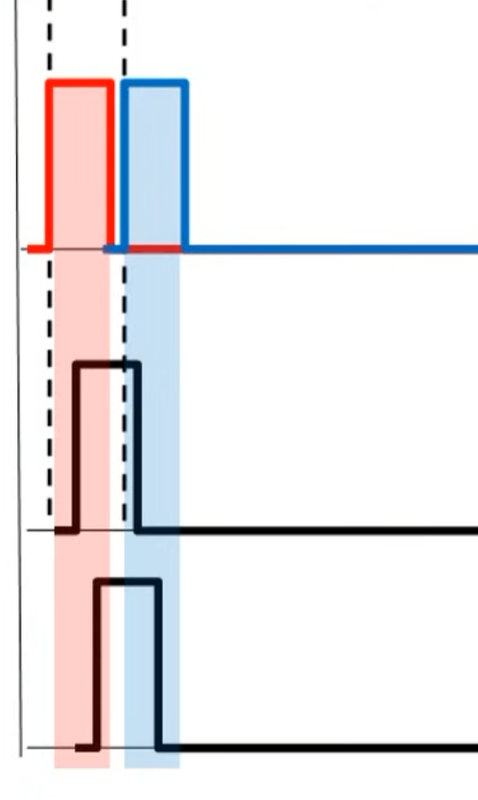
Sometimes they are called 'needles.' As a result, the impulse from the detector in a bright stripe slightly leads the identical one from a dark stripe. The lead is small, but it is always there. These impulses enter the input of a delay line, are delayed by 8 nanoseconds, and proceed to the coincidence circuit.
Electrical impulses from detectors D1 and D2, processed in a similar manner, arrive at the same circuit. Ideally, the 'needles' from D1 and D2 should reach the coincidence circuit at the exact same time.
But in reality, of course, that never happens. And there is always a slight shift. At these frequencies and durations, everything jitters, shakes, and drifts. As a result, in a bright stripe, the signal from detector D0 coincides more frequently with the signal from D1, while in a dark stripe, it coincides with the signal from D2, which is exactly what we see on the graphs.
Of course, the experimenters could have fought this phenomenon and beaten it. There are ways. Developers of laser rangefinders know how to do this.
But in that case, the standard Young's double - slit interference would vanish, and the quantum theory of the observer's delayed influence on past outcomes would fail to be confirmed.
They wouldn't get Nobels for that, and no one would dump quantum grants on them either. On top of that, their sensational transmission of information from the present into the past would go completely down the shitter. Therefore, the effect was not eliminated; instead, it was thoroughly and painstakingly re - tested. After all, if they keep trying hard enough, they’re bound to get something.
And honestly, how could it not work out when Kim and his buddies can mathematically slice 'noise' and 'signal' out of this effect?
The only question is, how does one know where the actual noise is and where the actual signal is?
Where from? From the quantum revelation that the Universe unveiled to Johnny through a high - bandwidth connection while his consciousness was expanded to the max? They don't say. They write about how they found the signal. But how they knew it was actually a signal - they don't say.
One could assume other reasons for this effect, but in any case, the graphs in the description have absolutely nothing to do with light interference. It's warm and salty.
And, of course, what happens in reality has absolutely nothing to do with the delusional quantum theories of Johnny Wheeler and the rest of the quantum crowd. The craziest experiment in the history of science is indeed crazy.
I expected nothing less. However, Kim commands sincere admiration. To mystify the public so brazenly and so openly - that requires talent, courage, and sheer audacity.
Sign in to comment