

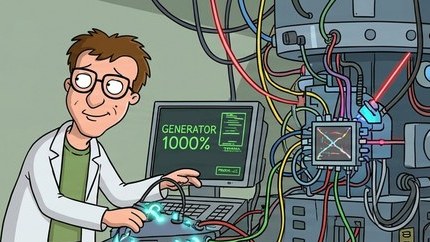
You have undoubtedly heard about quantum computers and their limitless potential. They’ve been buzzing and sprouting from every imaginable corner.
YouTube is flooded with hundreds of videos explaining how these quantum machines are structured and operated. Almost all of them open with the exact same hook: 'Quantum Computing: The Simplest Explanation.' What follows, however, is a stream of consciousness from pop-science communicators that only serves to further complicate and obfuscate the matter.
In the comments, people rightfully express their utter bewilderment and disappointment. The authors of these 'simplest explanations' then graciously apologize. apologize for the audience's stupidity and try to explain it all over again. This time, keeping it really simple. Literally breaking it down on their fingers. But they quickly run out of fingers, while simplicity and comprehension remain nowhere in sight.
Why is that? Because the inner workings of quantum computers are explained by Quantumists.
Asking a quantumist how a quantum computer works is like asking an Orthodox priest to explain the holy sacrament of Communion. A priest cannot simply tell you that taking Communion is merely checking in at the local church to show due reverence to the resident cleric.
A convict released on parole is legally obligated to report to a specific precinct. I, for instance, have been reporting like this for nearly two years now. Similarly, an Orthodox parishioner must occasionally report to the local church and check in with the local priest.
But a priest can never admit to this. If he did, the holy sacrament would instantly cease to be the ultimate divine mystery and turn into a mundane roll call of the rank and file. Consequently, the Body and Blood of Christ would immediately revert back to cheap wine and a cracker.
It is the exact same story with the quantumist-populizer. He cannot just come out and say that a quantum computer is just a regular computer, only with a fancier name. That it is structured exactly like a conventional one, except the spare parts it is assembled from carry different labels. And that its operating principles are identical to those of a standard PC, just described with a different vocabulary.
Now, I am neither a priest nor a quantumist. So, perhaps, I might actually succeed in explaining the quantum computer.
But let me begin with an analogy. A bit roundabout, perhaps. Please bear with me; this is absolutely vital for understanding the concept of any quantum project.
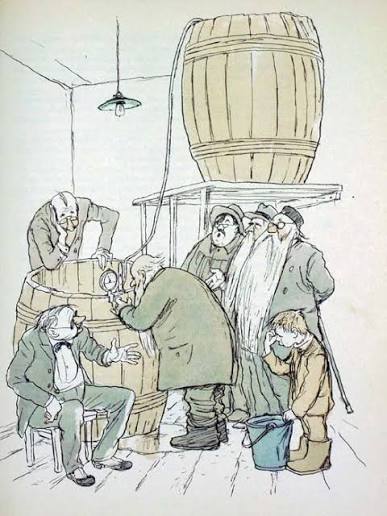
...A new establishment opened on Stinsky Boulevard under the signboard: Industrial Artel for Chemical Products "Revansh" [Revenge].
The artel occupied two rooms. In the first hung a portrait of Friedrich Engels, the founding father of socialism. Beneath it sat Koreiko, smiling innocently, clad in a grey English suit with a subtle red silk pinstripe.
The manufacturing process took place in the back room. There stood two oak barrels, fitted with pressure gauges and water-level sight glasses. One sat on the floor, the other on the mezzanine.
The barrels were connected by a thin enema tube, through which a liquid flowed with a businesslike gurgle.
Whenever all the liquid transferred from the upper vessel to the lower one, a boy wearing boiled-denim trousers would appear in the production room. Sighing with an un-childlike weariness, the boy would scoop the liquid out of the bottom barrel with a bucket, haul it up to the mezzanine, and dump it back into the top barrel.
Having completed this intricate manufacturing cycle, the boy would retreat to the office to warm up, while the enema tube resumed its gurgling. The liquid would once again embark on its usual journey from the upper reservoir to the lower.
Alexander Ivanovich himself had no precise idea what kind of chemicals the "Revansh" artel was supposed to be producing. He had no time for chemicals. His workday was already tightly packed as it was. He dashed from bank to bank, hustling for loans to expand production.
At state trusts, he secured contracts for the supply of chemical products and obtained raw materials at fixed state prices. He received the loans too. A vast amount of his time was consumed by reselling those obtained raw materials back to state factories at tenfold the price. And, of course, currency speculations on the black market swallowed up a tremendous portion of his schedule...
Now, take a look at this.
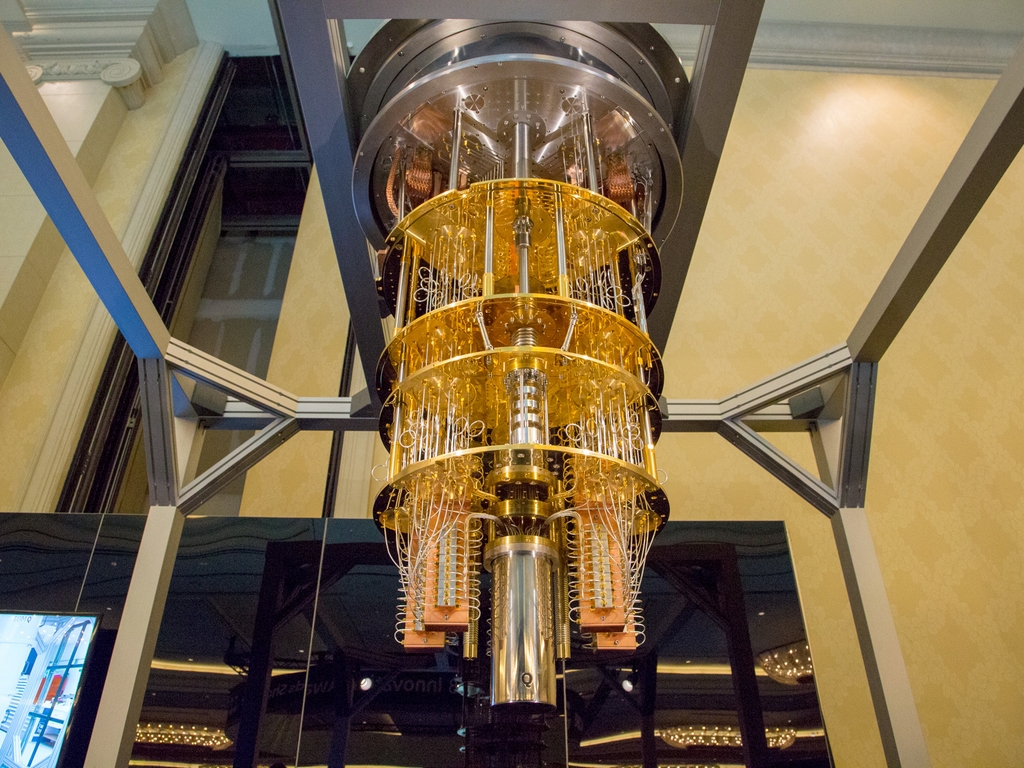
Recognize it? There is one barrel at the top, another at the bottom. Between them are enema tubes through which some substance flows. Quantum substance, presumably. Why else would the letter Q be stamped on the lower barrel? The boy with the bucket is also present, running around somewhere, reconnecting the tubes. And somewhere in the next room, Alexander Ivanovich Koreiko is sitting at his desk. Smiling innocently, he is busy pocketing quantum grants. Well, now you know exactly how a quantum computer works and what it is actually used for.
We could easily end the absolute simplest explanation right here.
However, apart from these quantum computers, there are others. Take a look, for example, at this 133-qubit Heron quantum processor by IBM. It is also quantum, so it probably works differently, right?
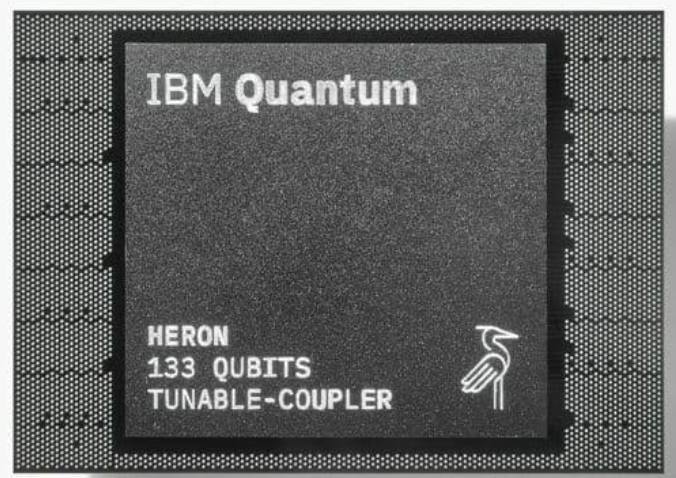
How exactly? Let us proceed as follows. First, I will outline the myth-opinion... oh, pardon me, we are dealing with science here, so we must say "interpretation" instead of "opinion" of an average quantumist-popularizer, just to avoid pointing fingers. And below that, I will provide a proper breakdown and a human-readable explanation. So, here it goes:
The foundation of classical computers is the basic data storage cell known as the Bit.
A bit is not a storage cell. A bit is a unit of information. The foundation of any computer is the Central Processing Unit (CPU). And the foundation of the CPU is the ALU, the Arithmetic Logic Unit. It is the ALU that handles data processing.
ALUs that process a single bit processors are generally not made. Even in the earliest and simplest processors, the ALU already operated with 4-bit cells. Most modern processors and their ALUs operate with storage cells that are 64 bits wide. Meanwhile, the particularly high-end ones feature working cells of 128 bits.
A bit is a physical device that can exist in two states, which we refer to as zero or one.
A bit is not a physical device. A bit is a unit of information. In computer science, it serves the exact same purpose as a meter or a kilogram does in mechanics, or a volt and an ampere in electrical engineering.
The physical device that actually stores the data processed by the ALU is called a register. The ALU registers in most modern processors are 64 bits wide and can store any number ranging from zero to 2 to the 64th power. And, naturally, they can exist in any state within that range. The particularly high-end processors work with registers that are 128 bits wide. Such registers are capable of storing any number between zero and 2 to the 128th power.
Now, 2 to the 128th power is a 38-digit number in decimal form. I will not bother writing it down here, simply because it would take up half the screen.
A quantum bit, abbreviated as a qubit, also represents an object capable of existing in two states, zero or one. This could be, for instance, an atom capable of being in a ground state or an excited state, or a quantum particle with a spin of 1/2, where the spin projection onto a certain spatial axis can take the value of +1/2 or -1/2, and nothing else.
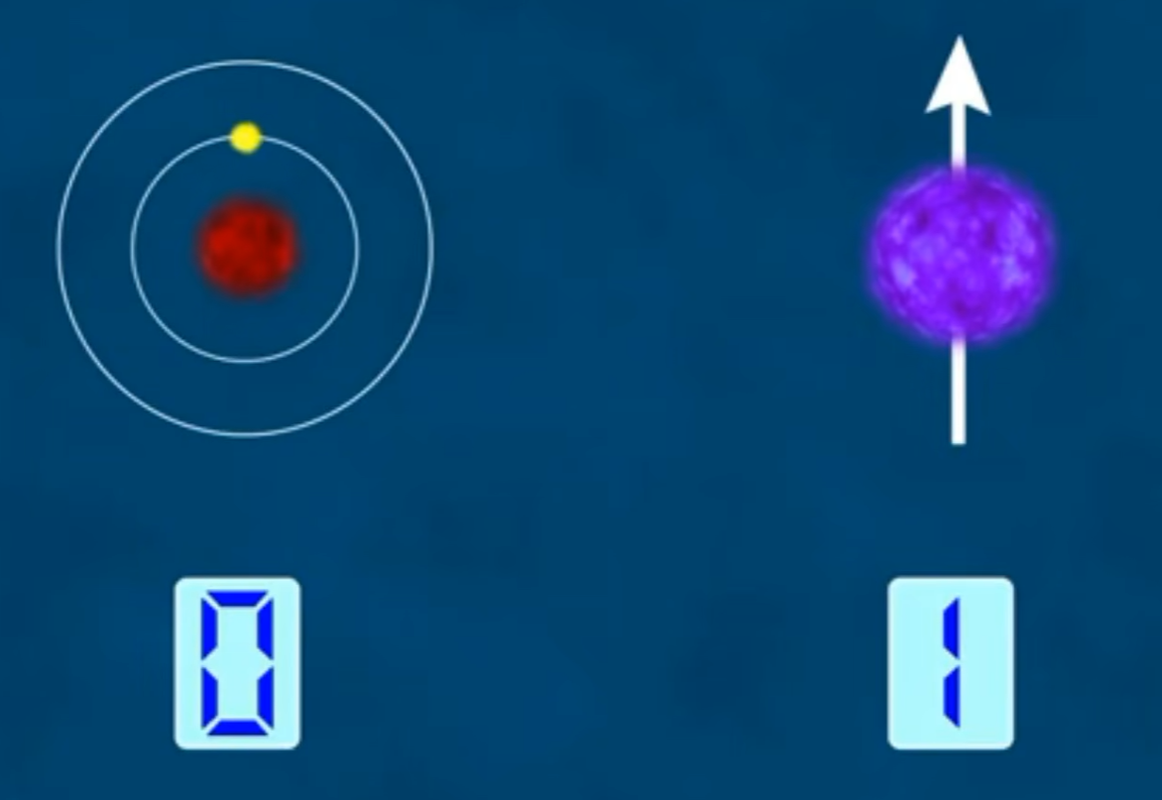
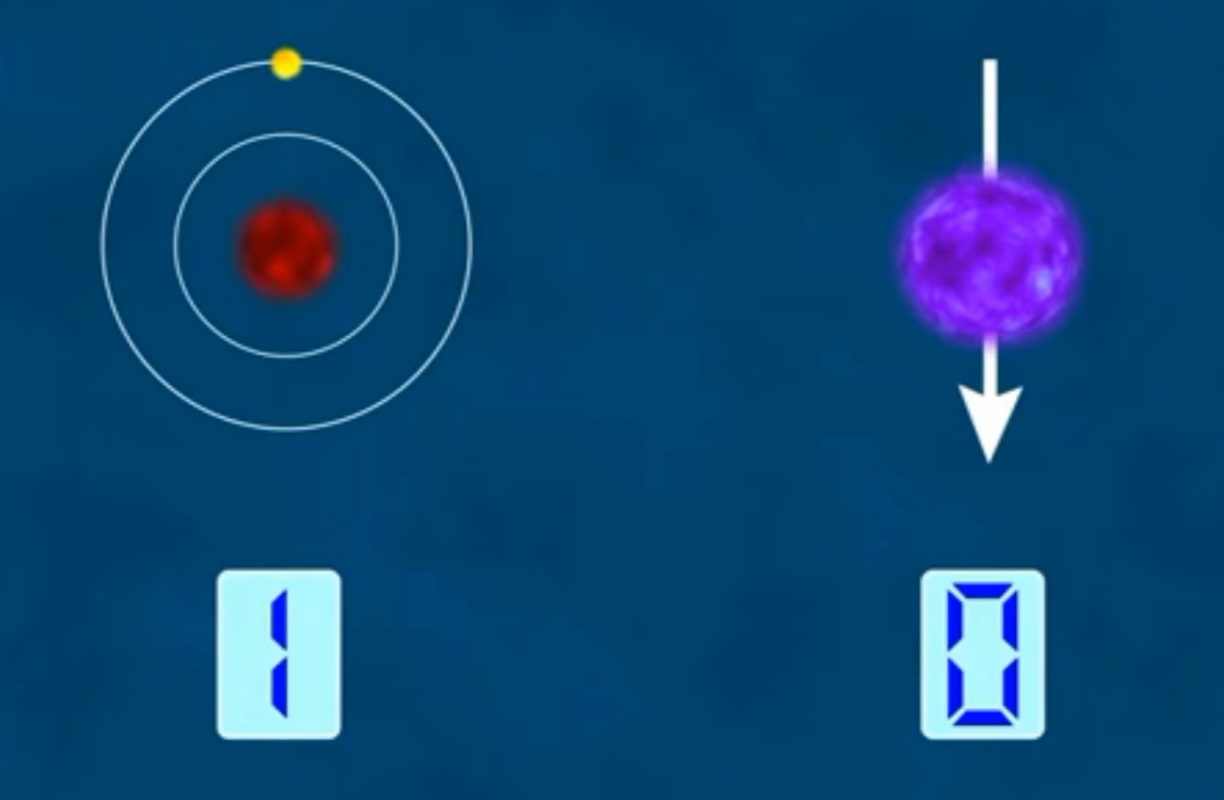
A qubit a quantum bit is neither an atom nor a particle; it is not an object of the real world at all. A qubit is a unit of information in quantum computing. It differs from a classical bit in that it is complex, constructed from two random real numbers whose squares sum up to one. This very randomness and paired nature make the qubit completely meaningless and useless as a unit of measurement for information. It is as if, when weighing a commodity, instead of using a single 1 kg weight, you used a pair of weights that could be completely different every time, yet always added up to 1 kg in total. In other words, a qubit is a meaningless vignette of a false premise. For this reason, qubits are naturally never used in practice.
Unlike a bit, which operates according to classical laws, a qubit obeys the laws of quantum mechanics.
Both the bit and the qubit are mere mental constructs of their creators. Both the bit and the qubit are simply definitions, defined as such by those who devised them. A bit is a unit of information in classical computer science. A qubit is a unit of information in quantum computing. Nothing more, nothing less. Neither classical nor quantum mechanics has any bearing whatsoever on the actual meaning of bits and qubits.
Classical physics is deterministic, while quantum physics is not. Therefore, a conventional computer obeys classical laws, whereas a quantum computer follows quantum laws.
No, of course not. Any computer, whether classical or quantum, is a physical object of the natural world. It operates not on some arbitrary principles of classical or quantum physics, but according to the actual design of nature—the structure of reality itself. And the laws of nature are universal, acting relentlessly and mercilessly.
A brick falling on a quantumist's head will produce a bump, the size and painfulness of which will remain entirely unaffected by whether that brick is represented as a classical, three-kilogram corpuscle or described as a weightless, elegant quantum wave function.
In classical computers, the carriers of information are bits—objects which, by their very nature, are capable of existing in only two distinct states.
A classical bit is a unit of measurement for the quantity of information in classical computer science; it serves the exact same purpose as a kilogram does in mechanics or an ampere in electrical engineering. The actual carriers of information in conventional computers are typically the magnetic domains of rigid metallic disks, the dark and light pits on the surface of optical discs, or the capacitance between the gates and substrates of CMOS transistors in memory chips, whether RAM or flash. Other, more exotic carriers of bits and bytes are used in computers extremely rarely.
By the way, as for those "two states".
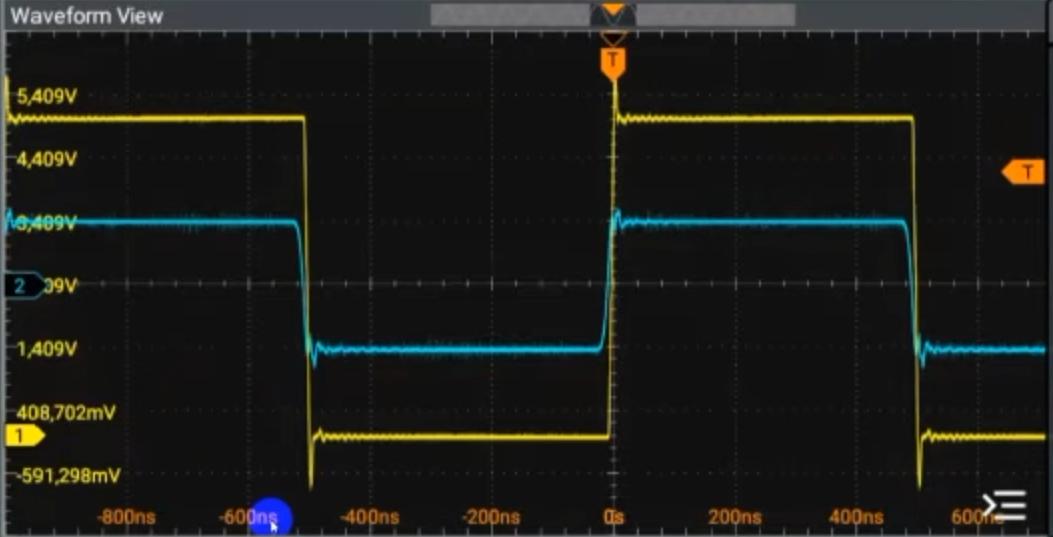
Do you see this oscilloscope trace?
The transitions are swift, yet by no means instantaneous. In fact, they are plagued by quite a bit of ringing and overshoot. Thus, you can easily catch a bit in a "transitional state." 😂
The quantum-mechanical counterpart of a bit, which lives by the laws of quantum mechanics, can also exist in a superposition of states. That is, a scenario is possible where, in a specific measurement, we can obtain our qubit either in an "on" state (1) or an "off" state (0), with a certain probability.
Neither classical nor quantum bits can exist in any states whatsoever. Both bits are merely units of measurement for the quantity of information. A classical bit is a unit for the quantity of information used in classical computer science. A quantum bit, or qubit, is a unit for the quantity of information used in quantum computing. Units of measurement are not physical objects and do not reside anywhere.
If you feed a binary number into a circuit, that is, a string of qubits, say, two of them, and in a state of superposition there will already be four possible variants: 00, 01, 10, and 11. The outputs of the circuit will also be fourfold, likewise in a state of superposition. This means that in a single action, the quantum logic circuit will perform four operations simultaneously. For three qubits, there will be eight such operations; for four, sixteen, and so on. The exact number of qubits is not even that critical. The action will always be executed just once. It is this very ability of quantum computers to simultaneously perform multiple operations on a superposition that serves as the main reason why they can solve certain mathematical problems so incredibly fast.
Oh, absolutely. A quantum computer will be able to crack a 128-bit key in a mere sextillion years (10^21), whereas a conventional computer would take a whopping octillion years (10^27) to brute-force it. Just feel the difference!
Trembling with sheer ecstasy, quantumists describe the operation of a quadruple inverter. In that case, I highly recommend the 7404 microchip. Admittedly, this little chip is slightly more powerful than a two-qubit quantum monster that resembles a moonshine still; it contains six inverters and performs six inversions simultaneously, without any clock cycles whatsoever. But I do hope quantumists will forgive this charming little microchip for such a blatant lack of tact.
Conventional classical computers possess, by their very nature, a built-in technology for executing multiple or even all computations in a single clock cycle. This technology is known as a lookup table.
An everyday example of such tables can be found right on the back cover of a school math notebook: an addition table or a multiplication table. The tables of sines, cosines, or logarithms operate in the exact same manner.
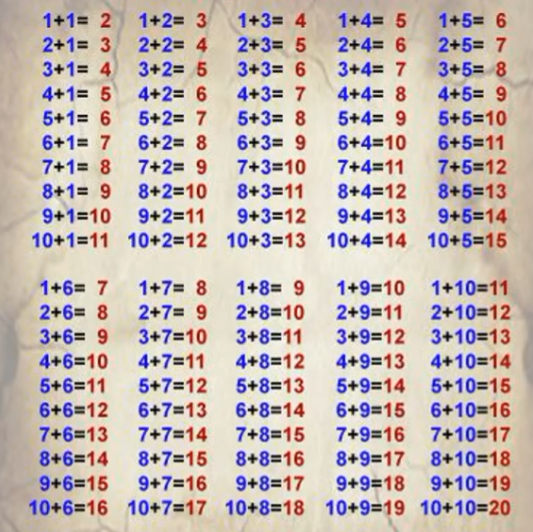
You simply align your ruler or finger with the query row on the left highlighted in blue and instantly read the ready-made answer on the right, highlighted in red. The result is obtained instantaneously, within a single clock cycle. Moreover, the computation speed is entirely independent of the magnitude of the operands, the multipliers, or the angles. The table delivers the result immediately.
This technology has been utilized for calculations for a very long time. For instance, tables of sines, cosines, tangents, cosecants, and logarithms were published back in 1746—long before the advent of finite-state machines, which execute tasks sequentially, step-by-step, much like today's conventional processors do. The table still works beautifully to this day. And you don't even need to change its batteries.
An electronic device that implements this tabular technology is called a PLD: "Programmable Logic Device". Any of these tables, or all of them combined, can be programmed into a single PLD, and it will deliver the ready-made result instantaneously, in a single read operation.
Such devices are used extensively whenever routine, repetitive tasks need to be solved at high speed. Naturally, one could also program a qubit, or any quantum operator, into a microchip of this kind. However, implementing qubits and quantum algorithms on a standard sequential processor is not particularly difficult either.
To put it plainly, a quantum computer is just a regular computer, only augmented with the capability to process quantum bits under the control of quantum algorithms—or operators, if you prefer.
A standard, modern, conventional computer, operating under applications written in various programming languages, is perfectly capable of handling integers, real numbers, and strings. Certain programs and procedures can also work with matrices, structures, tables, and complex numbers by utilizing the appropriate algorithms and operators. There is absolutely nothing stopping us from adding quantum tenants to this roster of residents—namely, qubits and quantum algorithm-operators.
All that is required for this is to teach the relevant compiler to allocate memory for qubits and to write procedures that implement all those Hadamard, Shor, and Pauli-Z operators, along with all the other quantum horseshit. And here is an example of the simplest quantum operator in Python:
# To run this, you need to install the libraries: pip install qiskit qiskit-aer
from qiskit import QuantumCircuit
from qiskit_aer import AerSimulator

# 1. Create a quantum circuit: 1 qubit and 1 classical bit to record the result
circuit = QuantumCircuit(1, 1)

# 2. Apply the simplest operator—the Hadamard gate (H-gate) to qubit 0
# This step places the qubit into a superposition state: (|0⟩ + |1⟩) / √2
circuit.h(0)

# 3. Measure the qubit's state and record it into the classical bit
circuit.measure(0, 0)

# 4. Use the quantum computer simulator to execute the code
simulator = AerSimulator()
result = simulator.run(circuit, shots=1000).result()

# 5. Get the counts of "0" and "1" outcomes from the 1000 runs
counts = result.get_counts(circuit)
print("Measurement results (out of 1000 shots):", counts)
Now that we have cleared away all this quantum mist, let us finally find out how a quantum computer actually works, and what sort of clever quantum trickery is taking place in there.
Imagine that:
With your eyes tightly shut, you are striking a turbulent mountain stream with a stick. You are tapping out a specific rhythm to transmit "qubits" of information to the water. After that, you freeze and wait. "It is time." Now, you hold a microphone to the water and record it.
But you do not care about the general water noise. What you actually need is that subtle splashing of waves that was supposed to be left behind by the strikes of your stick. The splash from the stick is incredibly weak, whereas the roar of the mountain stream is overwhelmingly loud. Consequently, you have to repeat this entire procedure about ten thousand times. Well, just to be on the safe side.
After all, who knows, what if the splash was just noise, and the noise was actually a splash?..
Your hand is an analog processor-compiler. It compiles bits using a quantum operator.
The swings of your hand function as a Digital-to-Analog Converter. They generate a sinusoidal radio wave out of classical bits.
The stick striking the water represents a radio signal flying down via coaxial cables, through all the cooling layers of the gilded cylinder, straight toward the processor.
Along the way, this signal is heavily attenuated so that the heat of the macro-world doesn't "scorch" the finicky "qubits" or, more accurately, the quantum particles that are clouds of probability.
The incoming microwave of the exact required frequency strikes the qubit. If the pulse is short the so-called pi/2 pulse it shifts the qubit into that very same notorious superposition. If the pulse is longer, it flips the qubit into a "one." By directing pulses of various shapes, the classical computer nudges the analog system, forcing the currents or microwaves inside the chip to flow and overlap with one another in a specific manner.
Did you notice something? You are absolutely right!
Building a quantum computer using qubits is only possible if the quantumist discovers a way to force those qubits into states where they behave exactly like conventional bits. That is, to consistently yield a zero in one of these states and a one in the other.
It’s a total mind-fuck.
So, first, the quantumists create a qubit endowed with highly eccentric, fancy-pants properties that set it apart from a classical bit, and then they rack their brains trying to figure out how to turn that quantum bit back into a classical one. Can we just skip these theatrical antics?
Now that you have transmitted the information to the analog "qubit," you have to wait.
While the computation is underway, the "qubits" must not be touched under any circumstances.
At the very end, however, our "microphone" comes into play: a standard classical computer sends a final microwave pulse a readout signal into the quantum system. In response, a faint analog radio signal returns from the cryostat via the coaxial cable. This signal possesses both amplitude and phase.
This radio signal then hits a perfectly ordinary Analog-to-Digital Converter (ADC).
It is the exact same kind of converter found in your sound card when you speak into a microphone, and it transforms the sinusoidal radio wave into a standard array of "classical" bits.
Due to the "laws" of quantum mechanics, a single measurement yields absolutely nothing it merely spits out a random 0 or 1. Because of this, the entire process is restarted 1,000 or 10,000 times!
The classical computer aggregates these thousands of digitized signals and plots a histogram: In 85% of the cases we got a '1', and in 15% a '0'
Do you get the nagging feeling that you’ve been thoroughly bamboozled? Well, you have. A perfectly ordinary computer converted bits into qubits and then back again. As it turns out, this ordinary computer is perfectly capable of processing the qubits itself, receiving them back, deciphering on its own where the noise was and where the signal hid, and calculating the required result. And how exactly did it calculate that result? Oh, it is remarkably simple.
You see, the quantumist already knows in advance which part of the data received from the "qubit" was "noise" and which part was "signal."
The quantumist knows exactly what task he is solving and what the answer is supposed to be. But what on earth is the quantumist going to do if the answer to the task is not known in advance, making it utterly impossible to write a data-filtering cleansing algorithm to discard the junk?
Well, they don't write about that in the textbooks. And they certainly don't tell you about it in those YouTube videos. 😂
This is precisely why, for several decades now, there has been absolutely no progress. The quantum computer does not work. And it never will. Time is already proving it.
Sign in to comment