

"Media carry conviction only until you understand the subject"
(c) Mark Twain
Quantumists convince us that there is a Higgs mechanism, according to which all elementary particles acquire mass through interaction with a field, also known as the Higgs field. And today, big science is absolutely certain that this is exactly how it happens. Ever since 2012, when the Higgs boson was discovered in experiments at the Large Collider.
Yet I claim that this experimental "confirmation", in the form in which it was conducted, does not carry the slightest evidentiary weight, and therefore has no right to be called an independent test of the theory.
So who is right? Thousands of quantumists all over the world, or me, a girl with a humanities teaching education?
Let's break it down.
To confirm the hypothesis about the existence of the Higgs mechanism—the process by which elementary particles acquire mass—quantumists needed to discover the Higgs boson. Doing so is not cheap. The thing is, according to that same Higgs mechanism theory, the Higgs field in our universe today is in a so-called vacuum state with zero energy.
And also, in quantum mechanics, zero energy does not mean the energy is strictly equal to zero.
Even in a vacuum state, any field undergoes small fluctuations.
What matters here is that the Higgs field in the modern universe is in a state where Higgs bosons are absent.
To create this Higgs particle, you need to take two other particles, say, two protons, accelerate them as hard as possible with an electromagnetic field, giving them high kinetic energy, and smash them into each other. As a result of the collision, the kinetic energy accumulated by the particles will be released in the form of new particles.
The energy of these particles is equal to their mass multiplied by the speed of light squared, and it cannot exceed the collision energy:
And since the mass of the Higgs boson, according to the theory, was supposed to be around , a collision with an energy of around 120-250 Gev was required for the Higgs boson to be born.
The Large Hadron Collider made it possible to develop collision energies up to 6.8 TeV, that is, 6800 GeV.
So, if you launched the collider and waited long enough, you could be sure that Higgs bosons would definitely be born in the collisions.
And here, quantumists faced a second challenge.
The particle's lifetime is only 10-22 seconds. And recording its existence in such a short window of time is quite a task. (I would say impossible)
But you can record the decay process of Higgs bosons by the products of this decay. There are many ways or, as quantumists say, decay channels of the Higgs boson, but the most interesting variant is the decay into two photons. The total energy of which must be exactly equal to the mass of the Higgs boson, which is somewhere around 100-200 GeV.
And once again, quantumists have a little problem.
When protons collide in the Large Hadron Collider, a multitude of different particles are born, including those more massive than the Higgs boson. These particles also decay rapidly, and during their decay, they can also emit photons or other particles that decay into photons. Furthermore, charged particles emit photons, including high-energy ones, as so-called bremsstrahlung (braking radiation) when a particle slows down during interaction with other particles after being born. In other words, if a quantumist simply turns on the collider and measures the energies of the photons coming out of it, they will see photons of all kinds of energies, including energies around 100--200GeV.
And by no means all such photons will be linked to the decay of the Higgs boson. But that is exactly the point: the decay of the Higgs boson would yield not just any photons in the 100--200GeV range, but photons of a strictly specific energy lying somewhere within this range. Without Higgs bosons, the photon energy spectrum, that is, the frequency with which quantumists record photons of a given specific energy in the Large Hadron Collider should have looked something like this:
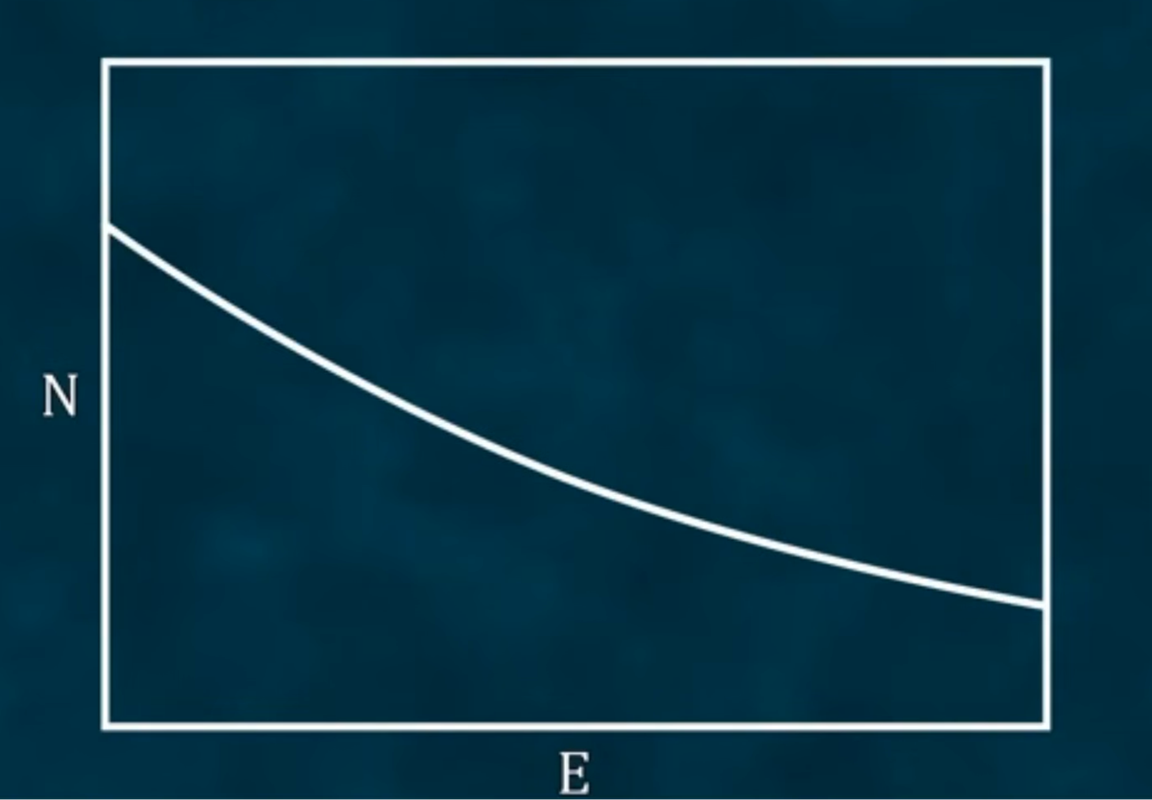
But if the Higgs boson exists, a peak should have appeared on this curve at the corresponding energy, equal to the mass of the Higgs boson multiplied by the speed of light squared.
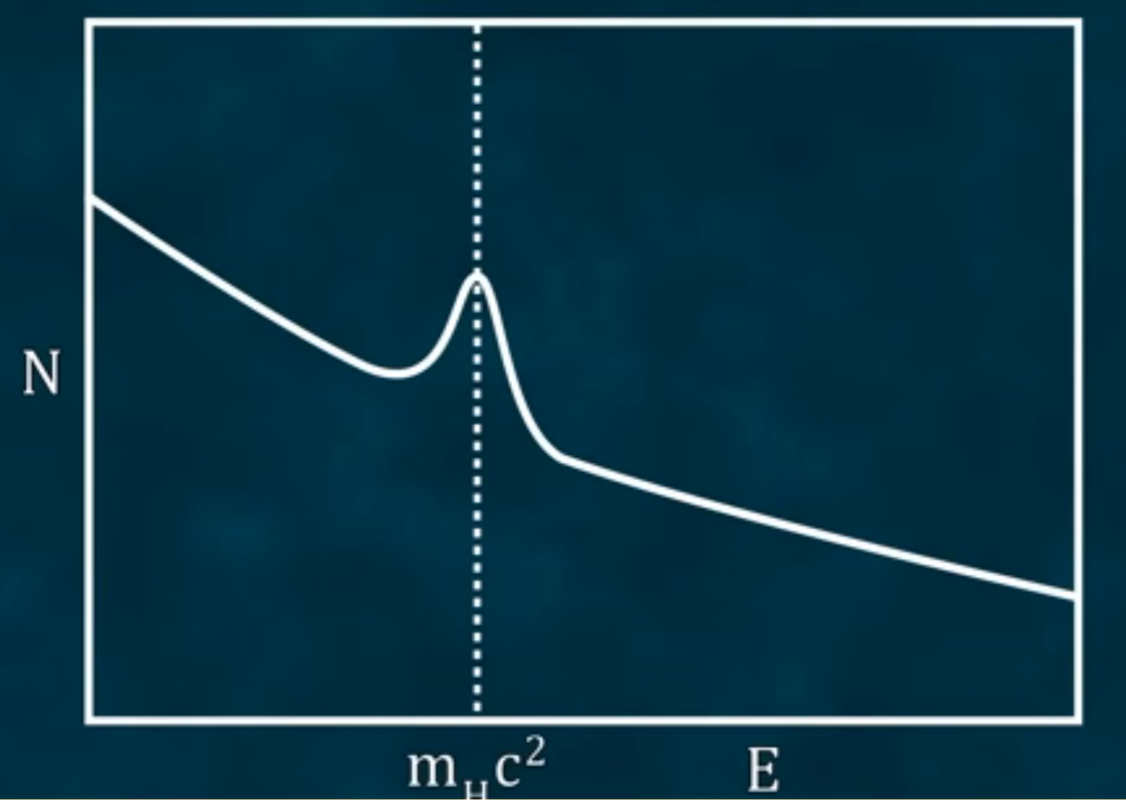
Well, finally, we have gotten to something substantial.
Here is where the quantumists are screwing us over.
Take a close look at this curve. On the horizontal axis is the event energy value Ei.
On the vertical axis is the number of such events Ni.
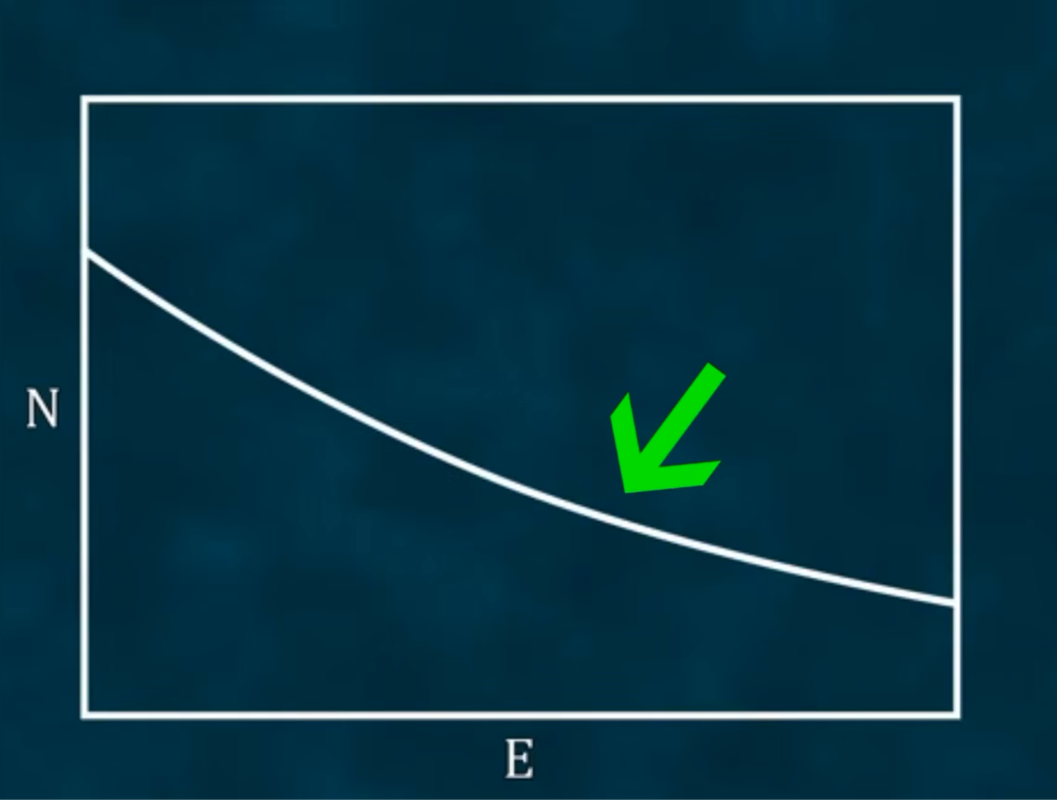
Obviously, the sum of the products of the number of particle registrations and their energies equals the total sum of all events:
And if we are to believe the quantumists, the total energy of all events equals the product of their mass—the product of the mass of the colliding protons and the speed of light squared—plus their kinetic energy.
That is absolutely it! That's the absolute maximum you can squeeze out of proton collisions in the collider. That means the area of this figure under the curve is the entirety of the available energy that can possibly be recorded.
And now, look at the bump:
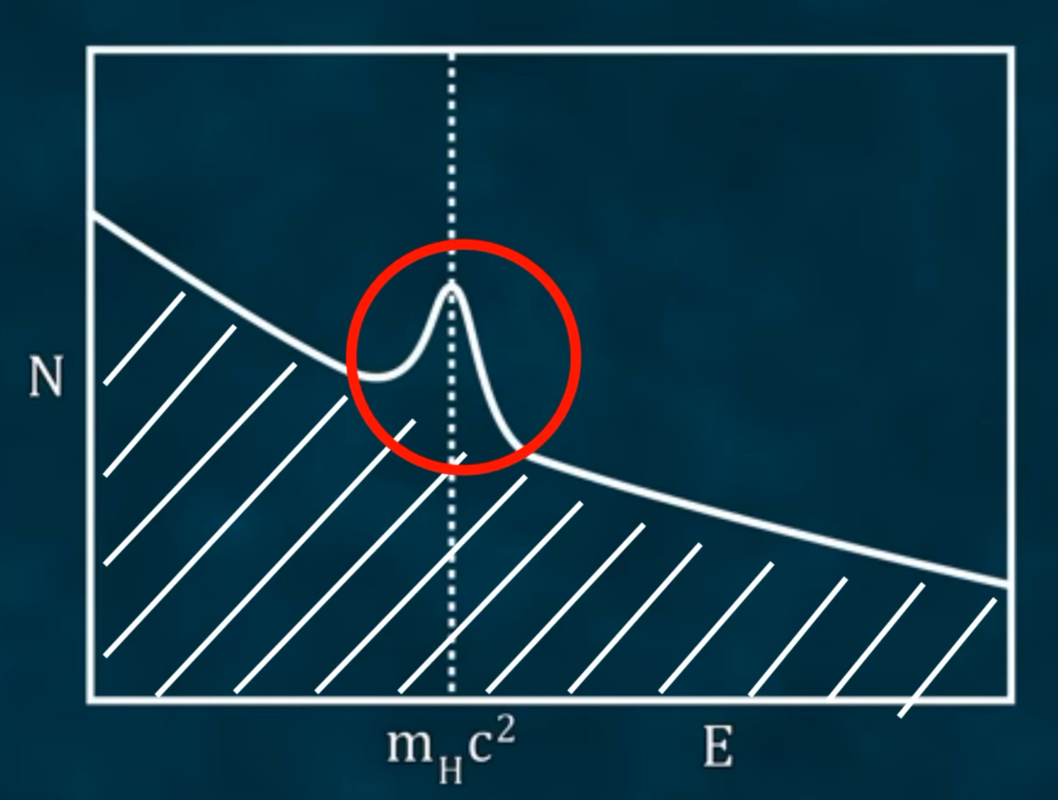
Here is the Higgs boson energy. And all of it sits right on top of the curve. And all of it goes above and beyond what is allocated by quantum physics and the law of conservation of energy.
Yes, the method of discovering Higgs bosons, which pop-sci talks about while choking with excitement, requires a blatant violation of the law of conservation of energy.
Higgs decay events cannot add energy to the common pot. They can only borrow it from other events with the same energy.
If you attribute this part on top to Higgs bosons, then you'll have to write off the exact same amount from all the others at the bottom. The colliding particles simply cannot have any extra energy.
Which means no bumps can be detected on the graph in principle. The narrative could very well end right here.
But I still have more to say 😏
In the end, gathering the statistics took about 2 years, in 2011–2012.
In the process, quantumists produced about 1014 proton-proton collisions, spending something like joules of energy on accelerating the protons. That is as much as a small city consumes in a month or two.
The result of all these efforts was this very same little hump in the photon energy spectrum, which was interpreted as a sign of the existence of the Higgs boson with a rest energy of 125 GeV and a mass of kg.
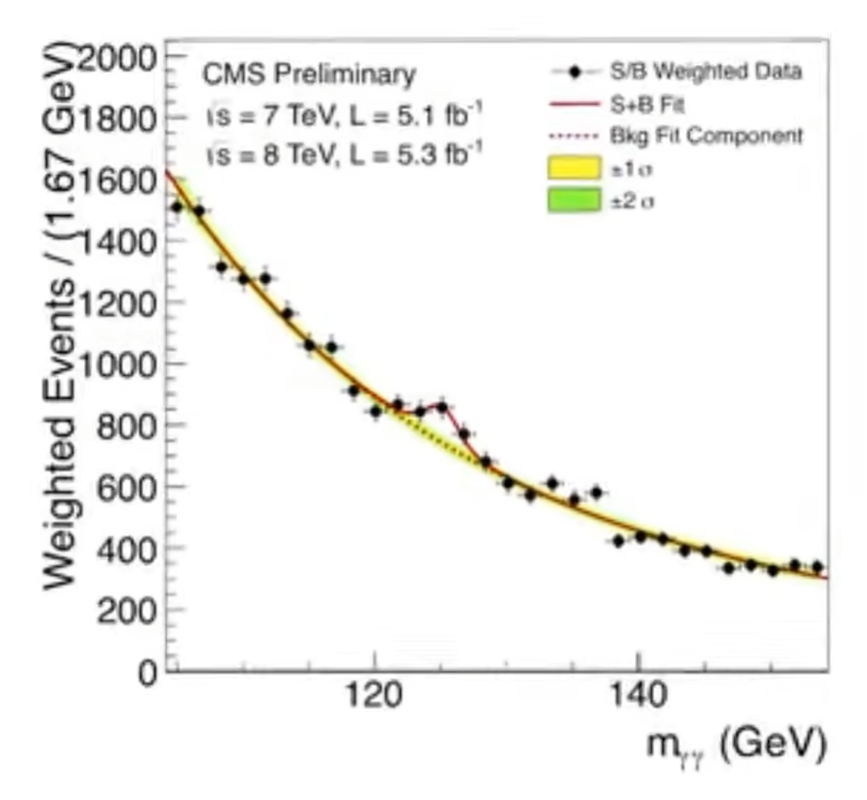
These wasted resources are usually spoken of with pride. “I dropped a hundred trays before bringing one to the table.” Inspires respect! Yes, there is clearly something to be proud of here.
And how much money went into the construction, the repairs, the service, the maintenance of the Large Hadron Collider? Not to mention the experiments conducted on it…
The quantumists expected to find the particle in a certain mass range, and they found it. Cross my heart?
Here is how the quantumists are screwing us over. Again.
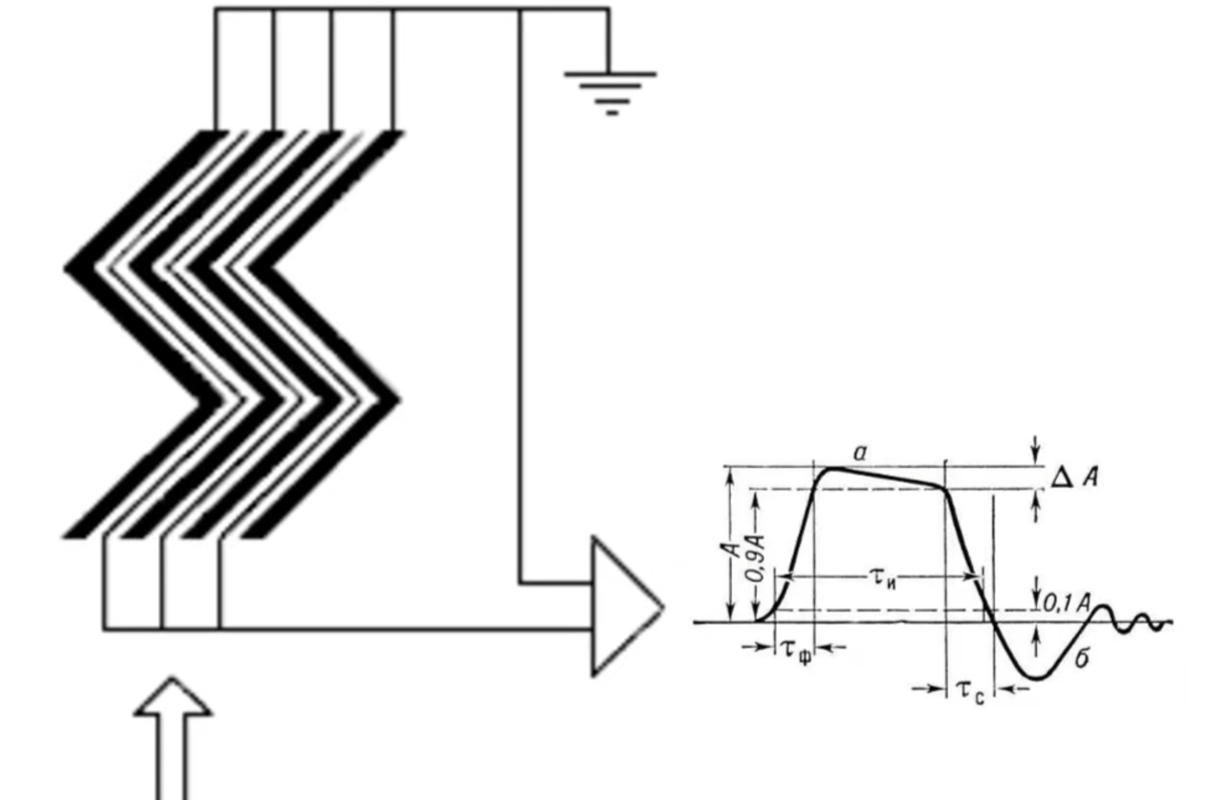
The Atlas detector calorimeters (the very ones that record the energy of proton debris) are macroscopic devices, and they, of course, are incapable of recording individual particles. This is a drawing of the barrel module of the electromagnetic calorimeter. Of that very same Atlas:
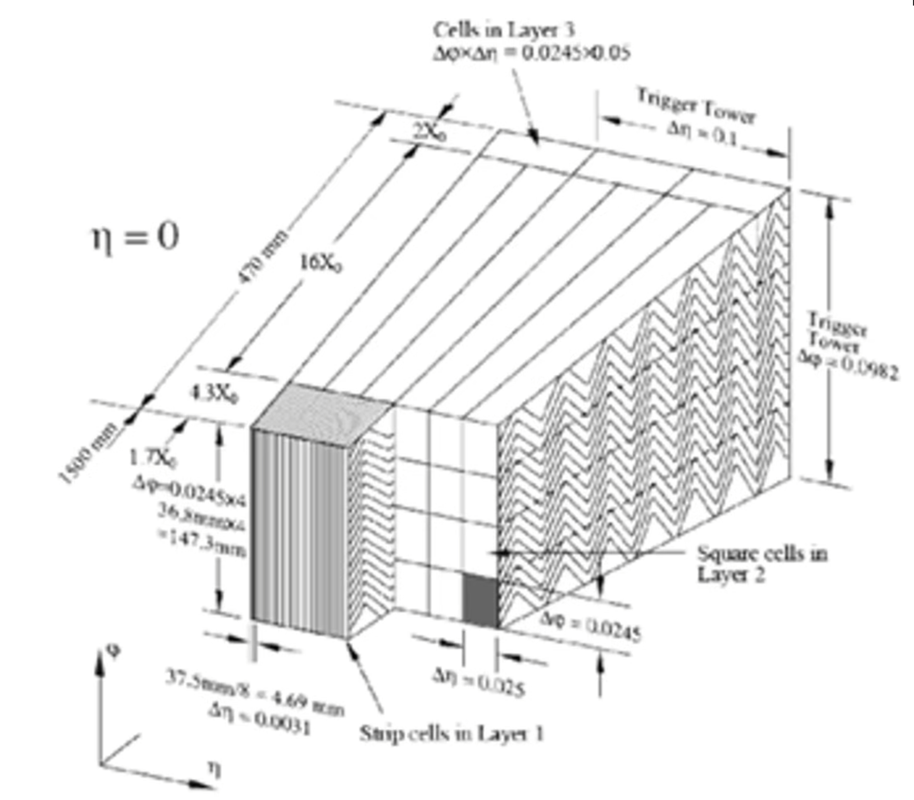
The module weighs 57 tons. 57 tons of lead inside these accordions.
This right here is where everything formed during the collision of matter particles in the collider’s active zone flies into. Inside this volume, 90% of the energy of whatever flew in is absorbed and recorded.
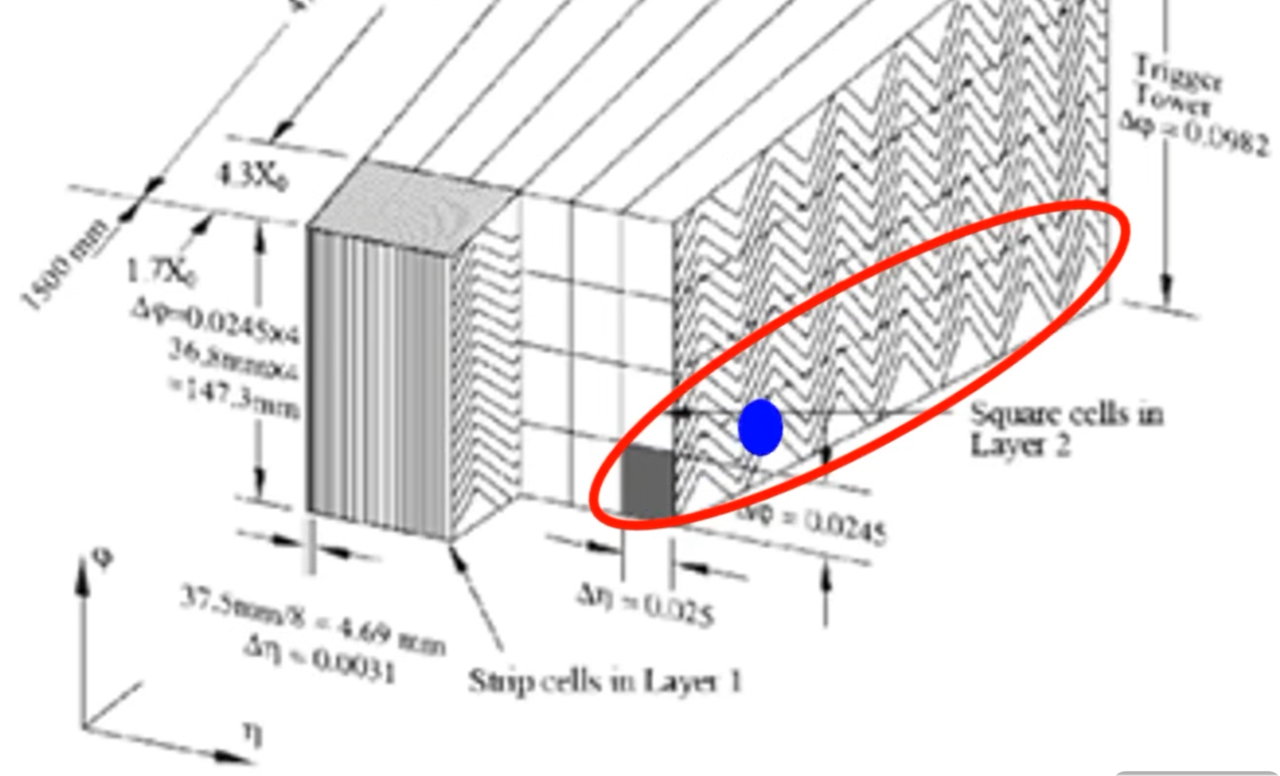
This emission slams into the lead accordion and is absorbed in the lead, releasing electrons. The big physicists call this emission beautifully: an “electromagnetic shower.” I’m literally dripping wet just from that name. The way it sounds.
These electrons enter the space between the lead plate and the electrode, which is filled with liquid argon, and ionize it, knocking out secondary electrons. As a result, a current pulse occurs in the cell's measuring circuit, and by its width and magnitude, one can judge, very-very approximately, how much energy flew into the cell:
I couldn’t find any data on the energy measurement error for particles in the Atlas electromagnetic calorimeter, but I did manage to find out that the sensitivity of the Atlas lead-argon calorimeter is 10% of the measured energy.
This means that the error when measuring an energy of 125GeV is at least plus-minus 25GeV in terms of absolute measurement error. Well, that corresponds to roughly a twenty percent relative error. What on earth are they measuring there?
A cell with a volume of more than half a liter distinguishes neither individual particles nor their individual energies.
One big particle, three small particles, 666 teeny-tiny particles - no difference.
A cell with a working volume of 0.7L will click once and then wait for the next incoming hit.
I’ll sum up the interim results. In 1964, Mr. Higgs pulls the Higgs mechanism, the Higgs field, and the Higgs boson out of thin air.
In 2001, construction of the Large Hadron Collider begins. In 2008, they finally threw it all together and turned it on, solemnly declaring a grand success. A week later, a superconducting magnet crapped out, and the LHC was shut down for a year of repairs.
After that, until 2014, it operated at reduced energy, just puffing along at half-mast.
It was precisely this period that was used to discover the Higgs boson. The LHC wasn't good for anything else noticeable. Even the small black hole that the big physicists flat-out promised didn't pan out. From 2014 to 2018, they tried to fire this whole contraption up to its design energies. However, once again, nothing came of it. And in 2018, the LHC was shut down again for repairs until 2022, and later they pulled the plug on it altogether due to electricity overruns.
A total of 20 years of life and roughly 20 billion euros spent, not counting additional associated infrastructure costs.
20 yards of euro cash, 20 years of stubborn work by big physicists. All to give birth to one single bump, which was interpreted as the possible decay of a possible boson. And zero accountability.
A dream job.
Sorry, I got distracted from the topic. We left off at the calorimeter having a huge measurement uncertainty. So where did the bump even come from?
There is this exotic type of electronic musical instruments that work on white noise.
What is white noise? It is a sound similar to a hum or a hiss. That is how pipes sound when water runs through them. That is how a TV hisses when there is no signal. That is how a kettle rumbles as it comes to a boil. That is how a transistor noises when electricity runs through it backward…


Graphically, white noise looks something like this:
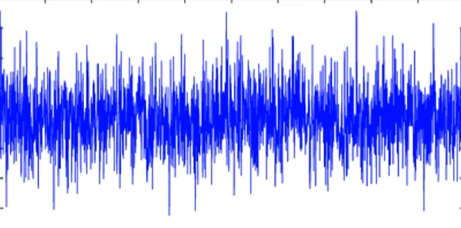
That means all frequencies are present in white noise at once.
If you want, you can hear Mozart's 40th, the US national anthem, or even the Beatles in it.
Well, if you feed such a signal into a narrow-band filter, the filter will will isolate a single frequency corresponding to its setting out of this sea of frequencies. Any frequency you want from that white-noise range.
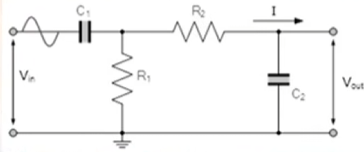
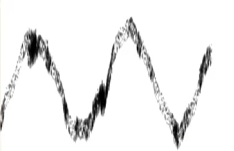
Just like that, the beams of matter particles hiss upon collision in the collider's active zone, shattering into countless small debris. More precisely, the collider noises in a “pink” way. That is how rain sounds when drops of different masses strike the roof at different speeds.
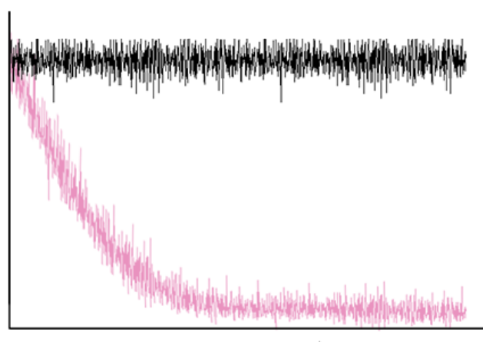
This kind of spectrum, where there are more low-energy events than high-energy ones, is called pink or red noise. The collider's active zone noises across a wide energy range, producing pink energy noise.
And all it takes to discover the Higgs boson, quark-gluon plasma, and similar quantumist crap is to hook a digital filter up to the Atlas detector, tune it to the required energy, and get the desired digital bump on the output, and the desired graphic bump in the right place on the chart.
Is there such a filter on the LHC? Of course there is. Here is the log from the ATLAS experiment:
“Data Acquisition System.
A three-level trigger system is used for the preliminary selection of “interesting” collisions.
The primary trigger is a massive factory of custom-built processors. Moreover, the selection happens at the hardware level.
The primary trigger lets through roughly 1 out of 400 events.
The passing events are analyzed by secondary and tertiary triggers, which evaluate the events via software.
These triggers consist of factories made up of nearly 2,000 computers. They let through approximately one out of 450 events.
As a result, at a nominal collision frequency of 40MHz (40 million collisions per second), “interesting” events arrive at an average frequency of 200Hz, or 200 events per second. Each of these events constitutes about 1.5megabytes of data, and it is recorded for further analysis. To analyze the events and run simulations, the members of the ATLAS collaboration have 36,000 computers at their disposal worldwide.”
The Atlas data acquisition system represents a very tight and difficult-to-penetrate filter. Only one interesting event out of 200,000 uninteresting ones is allowed out into the open, to the judgment of the general public. And who exactly decides which event is interesting and which is not?
Who prepares this abundant compound feed for 36,000 computers worldwide? How do they know that these events are truly important, while the others are just noise and trash? How can one tell if the collisions at the LHC perhaps disproved or proved the theory?
Make an educated guess. That is your homework assignment. 😂
As you can see, with the help of the Large Hadron Collider, one can effortlessly, and without any risk of exposure, discover any new particles in any quantity, at any convenient time, simply by selecting certain interesting events from a pile of uninteresting ones and soak up any budget.
Big physics is a goldmine, a Klondike, an Eldorado. Therefore, the priests of big physics will fight to the death for their “discoveries.” For the sake of their tithe, they would burn at the stake anyone who brings an argument against them.
By the way, take a look at the pictures and the Higgs pimples.
I found them in different scrap heaps:
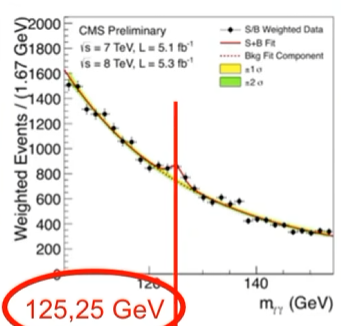
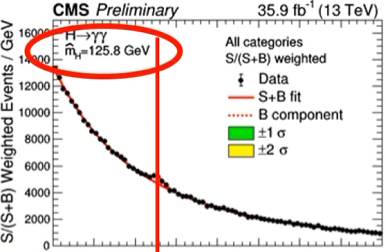
You see, they look graphically similar, but at the same time, the numbers vary wildly. One pulls exactly 125.25 GeV.
And for the other collaborators, it's also exact, absolutely exact, but 125.8 GeV. These collaborators couldn't even bother to lie in unison.
And really, why push yourself? The folks eat it up.
I once wrote about how the quantum eraser experiment was conducted. And there, it's the exact same story with data scrubbing. As the saying goes, doing it once doesn't make you a faggot - just happen.
But doing it twice! Twice is already a pattern. 😂
Then there are the relativists, and they are no less ferocious and just as dangerous to the development of science as the quantumists.
The relativists recently discovered a black hole. I’ll have to look into how exactly they pulled that off.
P.S.
And by the way, I lied to you. That quote from the article's epigraph never belonged to Mark Twain. I simply took advantage of your gullibility. Nakedly and shamelessly. And you wouldn't have swallowed the hook if you had checked the information. I hope you won't be offended by me for this?
I just wanted to demonstrate to you how it works. This is called the Gell-Mann amnesia effect. And I call it the duckling syndrome. It's a kind of cognitive bias. Whatever you see first is what you believe.
For example, your grandma told you in childhood that soup is good for you. And you know it. As an absolute truth. And when someone says that it’s not, you fill with righteous fury and scream “fringe crackpot!”, “dumbass!” You cuss because you have no other arguments. Yet a sense of injustice overflows.
But think about it: why do you have no arguments? Why is there nothing substantive to answer in a debate about soup? Have you ever checked if soup is actually good for you?
And what about the physics textbook? Have you ever looked at it critically?
And disabusing you of that notion won't be easy. You absorbed it at a tender age. From a person with unquestionable authority. And this experience has been with you throughout your whole life. And you are still alive. => Ergo, the experience is true and valuable. That's how the evolutionary mechanism works. But that is a topic for a whole new article.
People don't try to look into the formulas and formulations, and they don't understand what sheer gibberish these quantumist-mathematoids sometimes output. “Okay, okay, it's complicated, it's hard for me to think, I trust you.”
And later, you already know it to be so. After all, everyone says so.
Sign in to comment